
A Look Back: The Piceance Wild Horse Roundup
Roundups
Read time: 15 Minutes
Published: August 25, 2022
Written by:
AWHC Contributor
Earlier this summer, the Bureau of Land Management (BLM) conducted the largest roundup in Colorado history in the Piceance-East Douglas Herd Management Area (HMA) near Meeker. According toBLM documents, the HMA was the site of20 roundups between 1980 and 2017- a telling example ofBLMmismanagement.
The 2022 roundup slashed the estimated population of 1,385 wild horses to just 665 horses. The agency’s long-term goal is to further reduce the population in this 190,000-acre HMA to the low end of the “appropriate” management level (AML) of 135 - 235 horses.
The agency’s Piceance East Douglas “gather”pageis silent on the whereabouts or plans for the 59 horses that are unaccounted for. It is believed that they are mares held at an undisclosed location for 30 days for GonaCon treatment, pursuant to theBLM’sdecision recordandenvironmental assessmentfor the roundup.
Public Controversy
TheBLM’s Piceance-East Douglas wild horse roundup was met with widespread public opposition. The capture operation also caught the attention of Colorado Governor Jared Polis, First Gentleman Marlon Reis, and Congressman Joe Neguse (D-CO-02). They urged theBLMto delay the roundup, originally scheduled for September, due to thedeaths of 145 wild horses at the Canon City, Colorado holding facility and until other, less costly and disruptive alternatives for the Piceance wild mustangs could be discussed.
Ignoring the requests of Gov. Polis and Congressman Neguse, theBLMannouncedon June 13 that it would begin the roundup in July, citing lack of forage and water, and horses in poor condition. That decision sparked so much controversy that theBLMscheduled a virtual public meeting to explain its actions. Themeetingwas held on June 15, the same day the Colorado Sunreportedthat the governor’s office was disappointed by the BLM’s decision to move ahead with the roundup, calling it “costly and wasteful” and stating that the BLM ignored “cost-effective and humane alternative methods of management.”
At the meeting, theBLMpointed to drought, lack of vegetation on the range, malnourished horses, and damage to Greater Sage Grouse habitat as justification for the emergency removal. Elijah Waters,BLM’s northwest Colorado district manager, cited aBLMfield assessment of the horses. “Out of a sample size of 450 horses, we estimated that about 45% of 'em were in a body condition of three or less,” he explained.
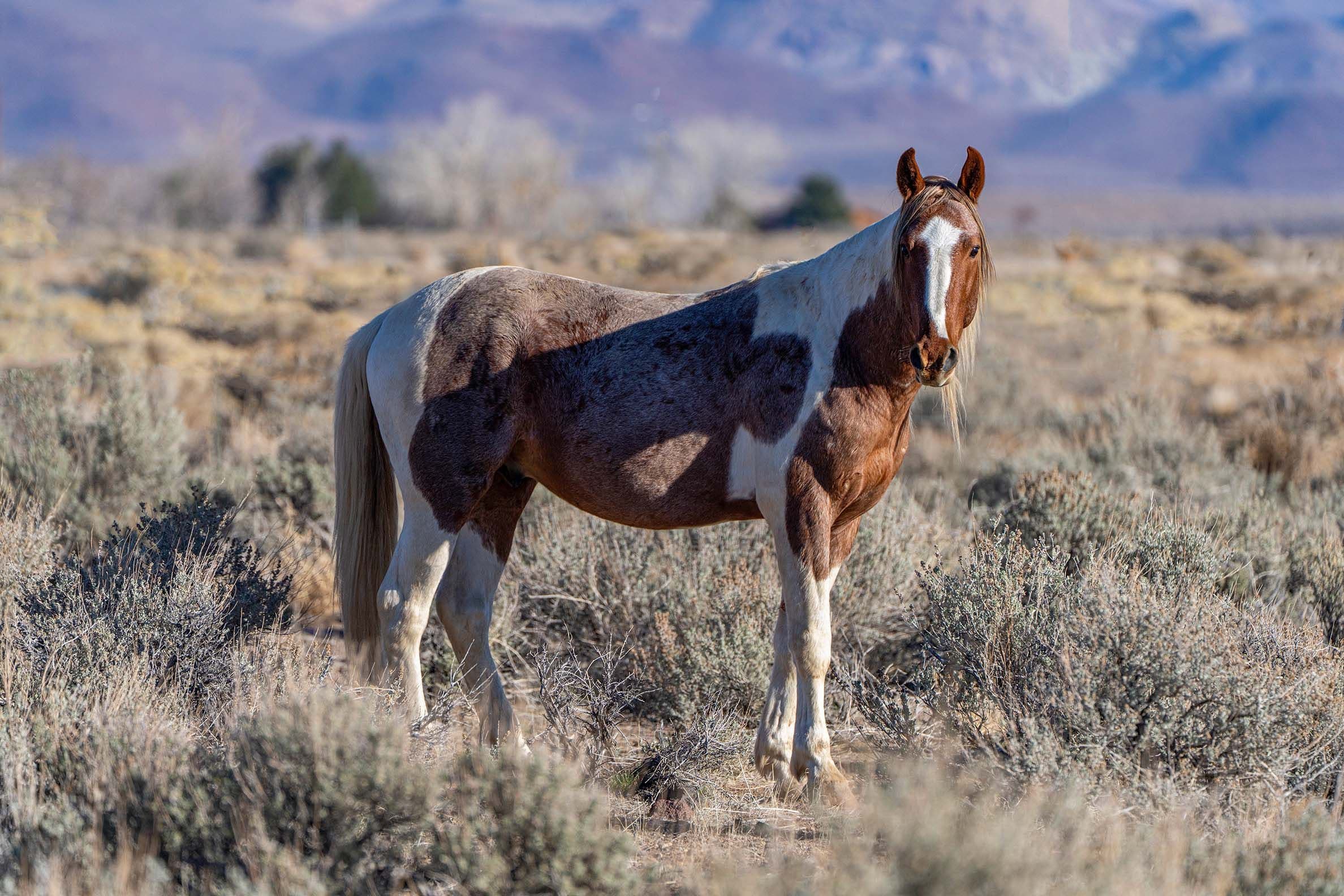
AWHC’s Scott Wilson, a noted wildlife photographer, traveled to the HMA shortly before the virtual meeting and found a different story. He said in an interview that he saw “stunningly healthy” wild horses and green grasses. “I was always very careful if I published pictures of green grasses, to say it's not like this everywhere,” he explained “But if you were to listen to theBLMnarrative, it wasn't like this anywhere!”
What About the Cows?
“Yes, there islivestockgrazing [on the Piceance-East Douglas HMA],” said Waters at the virtual meeting, adding that permittees were using only 40% of their allotted AUMs this year. (One AUM equals the amount of forage to sustain one cow/calf pair, one horse, or five sheep on the range per month.) Ranchers who have permits to graze are called “permittees” and are allotted a certain amount of AUMs for cattle and sheep. The wild horses are also allotted a certain amount.
This forms the basis of much of the conflict around wild horse and burro management in the West: Some ranchers say there are too many wild horses and burros on the range and they eat up all of the forage, leaving too little forlivestock. On the other hand, a2021 reportby the Public Employees for Environmental Responsibility (PEER) shows that cows outnumber wild horses 30 to 1 onBLMlands.
The forage allocation in the Piceance East Douglas HMA reflects this imbalance, with alivestockallocation of 57,105 AUMS – enough to sustain 4,759 cow/calf pairs or 23,794 sheep for a year, while horses are allocated a maximum of 2,820 AUMs, which equates to just 235 wild horses. That’s more than eight times more forage allocated to commerciallivestockgrazing - a discretionary use of thepublic lands- than to wild horses, whose protection is mandated under federal law.
PEERstatesthat theBLMscapegoats wild horses and burros for range degradation but that mostBLMgrazing allotments within HMAs fail the agency’s own rangeland standards. “Approximately 11.5 million acres of the 21.5 million acres of allotments within HMAs assessed byBLMto date, identifylivestockas a significant cause of that failure.” The report adds that “[o]f the almost 22 million acres of HMA area within allotments thatBLMhas assessed, only a tiny fraction - just 1% or 311,000 acre - has been identified as failing standards due to wild horses alone, with no mention of livestock.”
Western Watersheds Project (WWP), a rangeland watchdog group, agrees thatlivestockand theBLM’s lack of assessments of grazing allotments paints an inaccurate picture of true wild horse and burro rangeland impacts. In a2022 report,WWP showed that, in 2021, 54% of allotments and 67% of AUMs were legally renewed without updated rangeland analyses due to a loophole in the 1976 Federal Land Policy and Management Act, includingtwo allotmentswithin the Piceance-East Douglas HMA.
PEERadds, “[l]ivestock are by far the most frequently identified cause of allotment failure to meet standards for quality of water, vegetation, and soils, as well as the ability to support wildlife nationwide, including for allotments within HMAs.”
Conservation groups, including thenational Sierra Cluband theAmerican Wild Horse Conservation (formerly American Wild Horse Campaign), have called for the removal oflivestockor reduced grazing in HMAs to fully and accurately assess range damage.
Shifting Justifications
After Wilson’s photographs from the Piceance HMA in June showed a preponderance of healthy horses and grasses, theBLMembarked on a series of new and shifting narratives.
In early July, the agency turned its focus from the body condition of the horses to another justification for the emergency roundup: damage to the Dudley Bluffs Bladderpod (Physaria congesta), a rare plant species which grows only in a certain area in the Piceance East Douglas HMA. Thephoto used in an announcementabout the plant on theBLM’s Facebook page shows an overgrazed riparian area with a few horses. But, that area is actually in a dry bed of Yellow Creek, far from the home of Physaria congesta. The area is also part of alivestockgrazing allotment, but cattle are noticeably missing from the photograph.
On July 5, Colorado ecologist Delia Malone visited the area, including near where the plant lives. “Field observations document that these plants are abundant, vigorous, reproductively successful and that wild horses have had little to no negative impact on the plant or their habitat,” wrote Malone in a subsequentreporton HMA range conditions. Malone had previously studied the Dudley Bluffs Bladderpod and is familiar with the threats to the species’ survival.
According to Malone, the plant thrives in the shale barren ecosystem on a different part of the HMA than is shown in theBLMphoto. She said that, due to its federally-protected status, the exact location of the plant cannot be divulged. But, she added, “It never occurs in riparian areas.”
In short, theBLM’s claims about wild horses damaging the Dudley Bluffs bladderpod were unsubstantiated.
Malone’sreportconcluded:
- Dudley Bluffs bladderpod is not found in the area depicted in the BLM photo.
- Wild horses have not trampled the plant to near extinction.
- Wild horses are in good shape and not malnourished.
- Range conditions are not as dire as BLM’s assessment.
- Wild horses are not responsible for the bulk of the degradation.
“In my ecological perspective, the horses are not the problem,” Malone toldAspen Public Radio. “It's the cattle and the sheep that are severely damaging the landscape.”
The report was released on July 11. Two days later, theBLMagain shifted its narrative. Just over a month after claiming that 45% of the Piceance-East Douglas herd was in poor condition, theBLMbackpedaled. “Fortunately, rain has greened up the range,” said Eric Coulter,BLMspokesperson, tothe Grand Junction Sentinel. “And horses are now in the best condition, making it the ideal time to gather them.” In other words, the agency pivoted from “the range is degraded and the horses are starving so we have to round them up” to “the range is green and the horses are healthy so we have to round them up.”
Wilson said the roundup had little to do with range or body conditions and with so many foals and pregnant mares on the range, the timing was far from ideal. “The chief health emergencies facing these wild horses and foals right now are the impending helicopter chase across miles of hazardous Piceance Basin terrain and the prospect of years in government holding facilities,” he said after returning from the HMA.
Despite Malone’s report, official letters, and a tour of the HMA with the Governor, theBLMrefused to budge from its decision to remove wild horses from the Piceance in July.
The agency did, however, grant Polis’ request to have a state veterinarian on-site. “While I remain disappointed that this and other largeroundupscontinue to happen,” wrote the Governor in a Facebook post. “I'm heartened by the Bureau of Land Management accepting my offer to have the State Veterinarian's office on-site in the Piceance Basin during the upcoming wild horse gather, and by their additional responsiveness to the specific concerns I've raised for the health and safety of foals in particular.”
Roundup Begins
TheBLMbegan capturing wild horses on June 16 with a bait trapping operation that netted 18 horses.
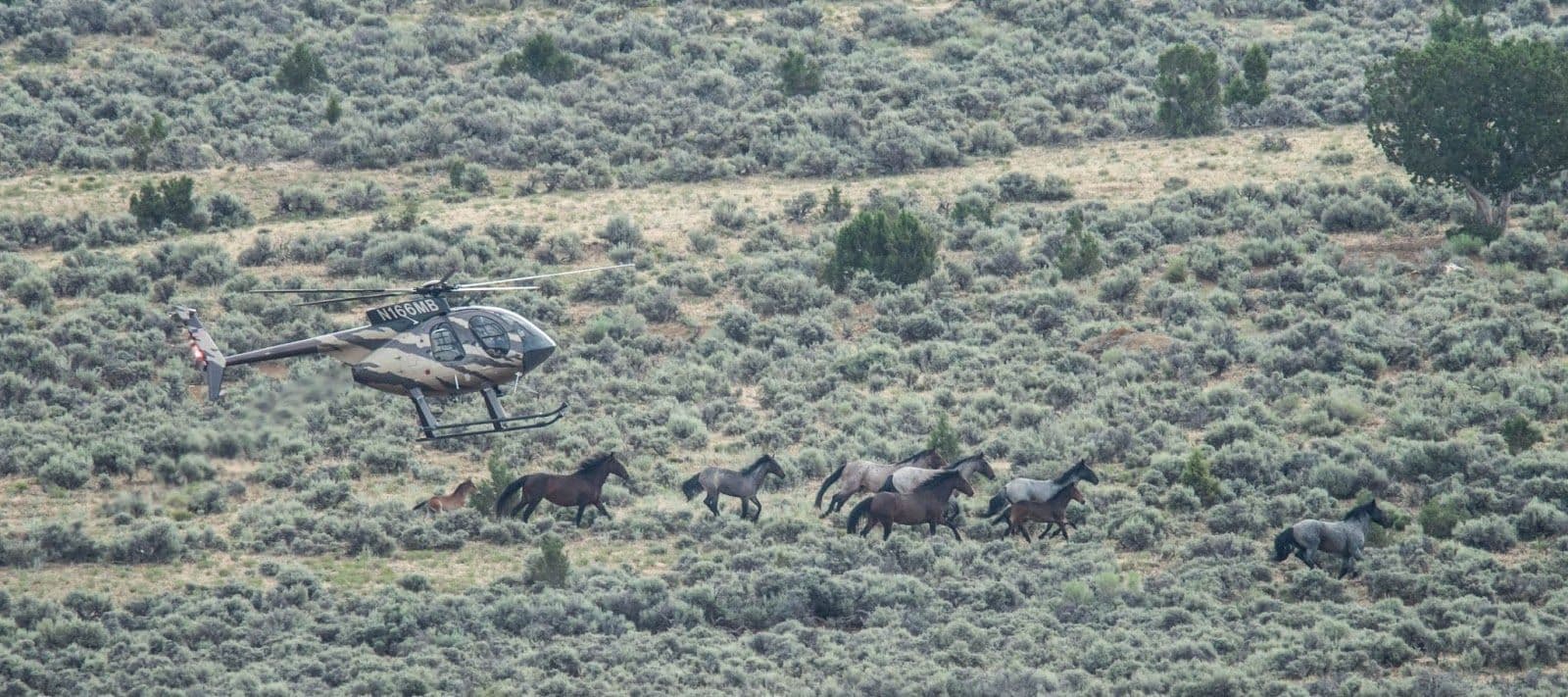
On July 15, the helicopter roundup began. Advocates expressed concern about the timing of the roundup during foaling season, when there are pregnant mares and newborn foals on the range. They were concerned as well about stampeding horses with helicopters in high summer temperatures over long distances. In response, theBLMnoted that it would take special care with foals and would move the traps frequently to limit the distances the horses are run. The agency also included in itsdaily reportstrap site temperatures ranging from the mid-70s to the mid-90s.
Wilson believes advocate concerns are helping to drive incremental improvements in operational transparency. While he clearly disputes the agency's decision to run the horses in hot weather for miles, especially pregnant mares and foals, he called the publication of temperatures in the daily reports a modest sign of progress. “Have you ever seen [theBLM] post temperatures in their daily reports before? That's a consequence of the advocate voice” he said. “We are holding theBLMaccountable. But, we are still a long way from the level of transparency which cameras in traps or on the front of helicopters would bring,” he added.
He was also on site, photographing the operations in Piceance Basin, and witnessed some painful situations, including the fence flip incident. “A mare suddenly and dramatically somersaulted, having been driven into some barbed wire,” Wilson explained. The wire fence was near the trap site but was unflagged, causing several horses, including a foal, to crash into it at a high speed.
Wilson said it shouldn’t have happened.
“This was right in front of the trap site,” he said. “It was an alarming consequence of not marking or clearing hazards properly.”
After the wire was flagged, the contractor continued to run horses through the same route but Wilson said they opened a small section of the jute run into the trap. “That just gave [the horses] an avenue to escape, which they did twice,” he explained. “And, I don’t know if it was frustration or the end of the day, but the pilot went home at that point.”
Another roundup day ended after about 20 minutes of capturing horses very close to the trap. “[The contractors] set up the whole trap operation complete with a helicopter,” he explained. “There was a band of what turned out to be 10 horses, honestly, 175 yards from the trap, and they fired up the helicopter, drove those horses into the trap, and then called it a day.” Wilson called it a waste of taxpayer money. “They could have sent in a cowboy and brought [the horses] in.”
Wilson vividly captured the fear and danger in crowded pens after the horses are stampeded into traps and separated from their families.
Helicopter Roundup Cut Short
AWHC launched astatewide media campaignto bring attention to the roundup, including print, social media and two weeks of prime-time ads on CNN, MSNBC, and Fox News in Denver. The ad campaign also featured a takeover of the Denver Post’s politics page and other digital advertising. “Over 19,000 Colorado citizens sent messages to their Congressional representatives, demanding an end to the Piceance Basin roundup,” saidSuzanne Roy, director of the AWHC, speaking of the overwhelming response to the ad campaign.
TheBLMceased operations on August 1, two weeks prior to the scheduled end of the roundup. The agency captured 867 horses, 183 fewer than thegoal of 1,050. TheBLMhad received approval to permanently remove 750 wild horses from the range, but ended up shipping a total of 761 to a holding facility in Axtell, Utah.
An Uncertain Future
U.S. taxpayers shelled out$559,250to CattoorLivestockRoundup Inc to capture and ship the Piceance-East Douglas horses to Utah. (The horses were shipped out of state because the Cañon City, Colorado holding facility remains closed after a respiratory illness killed 145 West Douglas horses there last spring.) That does not include long-term costs of warehousing those animals in short- and long-term holding facilities. Costs that, at theBLM’s estimate of $48,000 per horse, could run into the tens of millions.
Meanwhile, the agency continues to reassure the public that the captured Piceance-East Douglasmustangs- and all captured wild horses and burros - will be well taken care of.
But recentmustang rescuesfrom kill pens plusinternal assessments that document deficient conditionsat holding facilities tell a different story. And the agency’s Adoption Incentive Program (AIP) - which pays people $1,000 per animal to adopt up to four horses per adopter - isdirectly relatedto an influx of federally-protected wild horses and burros into the slaughter pipeline. (Just this month, AWHC worked withSkydog Sanctuarytorescue 16 BLM mustangsout of a kill pen in Eaton, Colorado. All of themustangsfor whom we received brand numbers were adopted through the AIP.)
All of this paints a bleak picture of off-range mismanagement plus a lack of oversight and accountability that jeopardizes the welfare of captured wild horses and burros.
AWHC’s investigations team will keep close tabs on the Piceance-East Douglas horses, including those removed, those returned to the range, and those who remain free.
Never Again?
As public and Congressional pressure on theBLMto reform its management practices grows, a new way of managing these icons of the America West is emerging.
On July 18, three days after the drivetrap roundup began in the Piceance Basin, Congressman Joe Neguseintroduced an amendmentto H.R. 8294, the Fiscal Year 2023 Appropriations Bill, that would prohibit funding forroundupsusing helicopters or fixed-wing aircraft. And reacting to abuse atroundupsthroughout the West this year, Rep. Dina Titus (D-NV) introduced theWild Horse and Burro Protection Actto ban the use of helicopters to capture wild horses. These legislative efforts are the latest in a decades-long battle against helicopterroundups. In 1959, theWild Horse Annie Act, which prohibited motorized vehicles and fixed-wing aircraft in roundups, became law. But, in 1976, that was reversed in Section 404 of theFederal Land Policy and Management Act.
Within the past year, the ColoradoBLMhas mentioned moving away from helicopter drivetraproundups. Bill Mills, the field manager for the White River Field Office, told theSteamboat Pilot & Today, that the goal for the Piceance-East Douglas HMA is “not ever have a helicopter back in it.” He said, “Once we get to the appropriate management level, we don’t want a helicopter, and we don’t want to ever send a horse to holding.” Colorado’s Wild Horse and Burro specialist, Steve Leonardsaid the same thingafter the 2021 Sand Wash Basin roundup.
The appointment of Doug Vilsack, formerly of Colorado’s Department of Natural Resources, as the newBLMColorado state director, offers an opportunity for reform and change. AWHC looks forward to working with Mr. Vilsack to improve humane management of Colorado’s wild horses, to ensure that fertility control programs have the resources they need to succeed, and allow political leaders like Governor Polis and Congressman Joe Neguese to lead the way to reform.
Thanks to everyone who sent letters, emails, and made phone calls to congressional leaders on behalf of the Piceance-East Douglas wild horses. You are making a difference! Pleaseclick hereto find out more about AWHC’s work and what you can do to help.
Amy Hadden Marsh, writer and editor, comes to AWHC from an award-winning background in journalism. Amy spent 15 years as public affairs show host, reporter, and news director for KDNK Community Radio in Carbondale, CO, winning several Edward R. Murrow and Colorado Broadcasters Association awards along the way. She has won awards for her print work from the Colorado Press Association. She has also been a freelance journalist since 1990, publishing in national magazines.
Subscribe to our newsletter: