
Bible Springs Complex Wild Horse Roundup Reports
Roundups
Read time: 16 Minutes
Published: August 5, 2026
Written by:
AWHC Contributor
Welcome to our roundup reporting page for the Bible Springs Complex in southwestern Utah, where you will find eyewitness reports, photographs, and videos from the field as the Bureau of Land Management conducts a major helicopter roundup.
The Bible Springs Complex includes the Bible Spring, Four Mile, and Tilly Creek Herd Management Areas, along with the Blawn Wash Herd Area. According to the BLM’s current national schedule, the operation is planned for August 1 through August 22 and targets approximately 800 wild horses for capture and permanent removal. None are currently scheduled to be treated with fertility control or returned to the range.
This operation will affect wild horses across several distinct public-land areas, separating family bands and sending captured animals into the federal holding system.
Our field observers will attend whenever access is provided to witness helicopter drives, monitor horse welfare, document roundup conditions, and provide the public with transparent, independent reporting.
This page will serve as a living record of the Bible Springs Complex roundup. Throughout the operation, we will publish daily totals, photographs, videos, and firsthand observations so the public can follow events as they unfold across the complex.
We hope these reports bring visibility to the scale and consequences of this removal and strengthen the call for humane, science-based management that protects wild horses and preserves viable herds on public lands.
Day 20 - 8/21/26
BLM concluded the Bible Springs Complex Round Up today, shipping the remaining horses.
Summary: No gather operations conducted
Animals Gathered: 0
Animals Shipped: 20 (2 stallions, 15 mares, and 3 foals)
Animals Released: 0
Deaths: 0
- Sudden / Acute: 0
- Pre-existing / Chronic: 0
Final Round Up Numbers:
Animals Gathered: 747 (268 stallions, 322 mares, and 157 foals)
Animals Shipped: 740 (264 stallions, 319 mares, and 157 foals)
Animals Released: 0
Deaths: 7
- Sudden / Acute: 2
- Pre-existing / Chronic: 5
Day 19 - 8/20/26
Animals Gathered: 12 (2 stallions, 7 mares, and 3 foals)
Animals Shipped: 146 (37 stallions, 59 mares, and 50 foals)
Animals Released: 0
Deaths: 0
- Sudden / Acute: 0
- Pre-existing / Chronic: 0
AWHC did not have an observer present today.
Day 18 - 8/19/26
Animals Gathered: 85 (25 stallions, 38 mares, and 22 foals)
Animals Shipped: 81 (53 stallions, 28 mares, and 0 foals)
Animals Released: 0
Deaths: 3
- Sudden / Acute: 0
- Pre-existing / Chronic: 3
One 2-year-old black stud with a neck infection; on-call vet agreed with the decision to euthanize
One 8-year-old bay stud was blind in the right eye; on-call vet agreed with the decision to euthanize
One 3-year-old bay mare was lame in front left leg with no prognosis for recovery; on-call vet agreed with the decision to euthanize
AWHC did not have an observer present today.
Day 17 - 8/17/26
Animals Gathered: 37 (12 stallions, 18 mares, and 7 foals)
Animals Shipped: 88 (40 stallions, 35 mares, and 18 foals)
Animals Released: 0
Deaths: 0
- Sudden / Acute: 0
- Pre-existing / Chronic: 0
AWHC did not have an observer present today.
Day 16 - 8/16/26
Animals Gathered: 67 (34 stallions, 23 mares, and 10 foals)
Animals Shipped: 0
Animals Released: 0
Deaths: 0
- Sudden / Acute: 0
- Pre-existing / Chronic: 0
AWHC did not have an observer present today.
Day 14 - 8/15/26
Animals Gathered: 21 (6 stallions, 12 mares, and 3 foals)
Animals Shipped: 44 (13 stallions, 22 mares, and 9 foals)
Animals Released: 0
Deaths: 0
- Sudden / Acute: 0
- Pre-existing / Chronic: 0
AWHC did not have an observer present today.
Day 13 - 8/14/26
Animals Gathered: 38 (20 stallions, 12 mares, and 6 foals)
Animals Shipped: 0
Animals Released: 0
Deaths: 1
- Sudden / Acute: 0
- Pre-existing / Chronic: 1
No information was posted by the BLM regarding the pre-existing/chronic condition.
AWHC did not have an observer present today.
Day 12 - 8/13/26
Animals Gathered: 22 (8 stallions, 11 mares, and 3 foals)
Animals Shipped: 92 (27 stallions, 42 mares, and 23 foals)
Animals Released: 0
Deaths: 0
- Sudden / Acute: 0
- Pre-existing / Chronic: 0
AWHC did not have an observer present today.
Day 11 - 8/12/26
Animals Gathered: 56 (12 stallions, 29 mares, and 15 foals)
Animals Shipped: 0
Animals Released: 0
Deaths: 0
- Sudden / Acute: 0
- Pre-existing / Chronic: 0
AWHC did not have an observer present today.
Day 10 - 8/11/26
Animals Gathered: 29 (7 stallions, 13 mares, and 9 foals)
Animals Shipped: 48 (13 stallions, 21 mares, and 14 foals)
Animals Released: 0
Deaths: 1
- Sudden / Acute: 0
- Pre-existing / Chronic: 1
No information listed by BLM regarding the pre-existing/chronic condition cited.
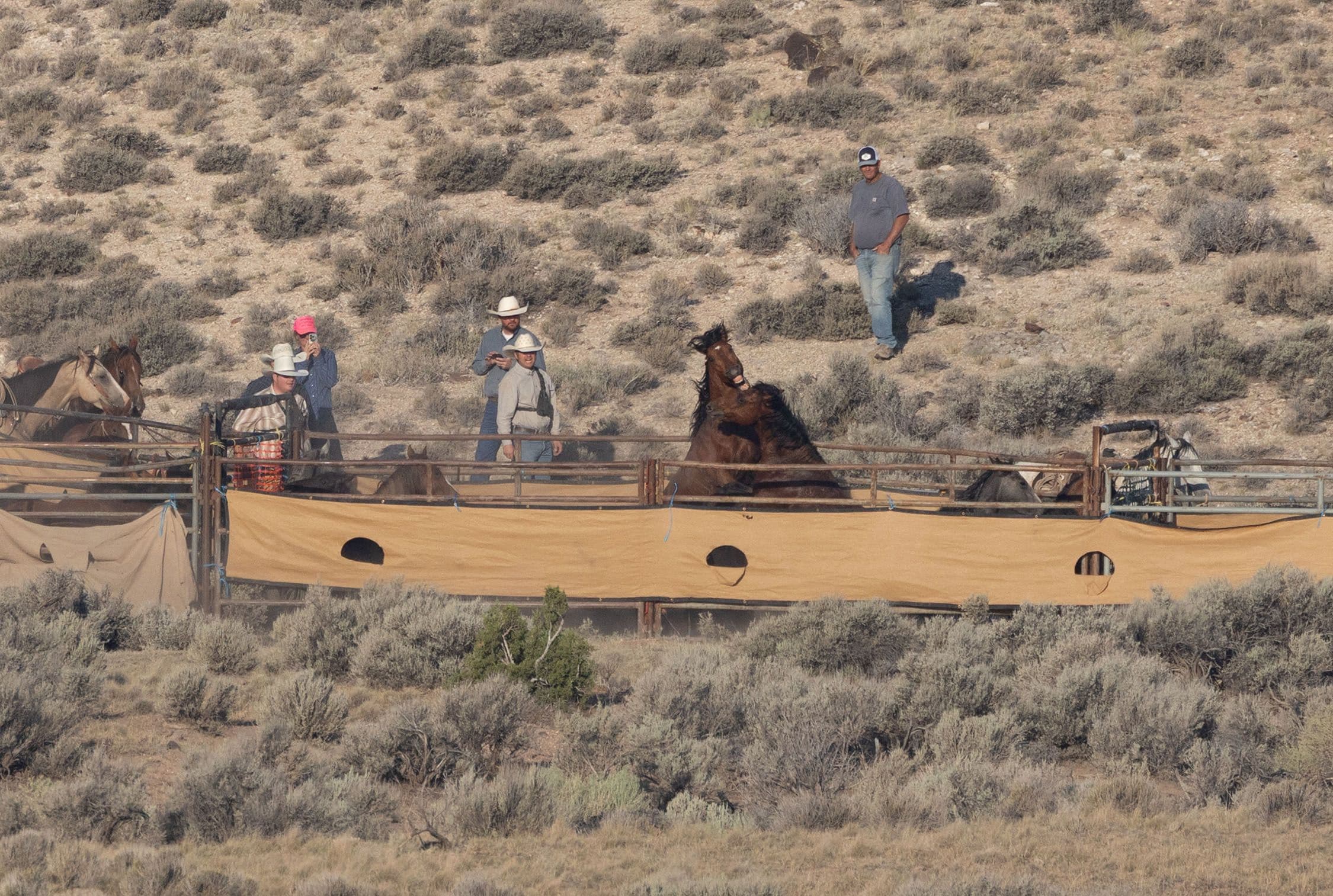
Observers were approximately ¼ mile from the trap, which was over a hill. They could see parts of the wings through scattered trees.
There were three runs today.
While observers were waiting to drive to temp holding, they were informed that there was a foal that had fallen behind from the large run yesterday morning. This was out of their sight. They had gone out and looked for the foal, but didn’t find it. While out looking for horses today, they found the foal, caught it, and flew it in the helicopter to the trap where they gave it Foal-Lac. The foal was doing ok. His dam had already been shipped to Axtel this morning, so the foal will be put into foster care. The other two foals previously put into foster care are still doing well.
Observers visiting temporary holding. The horses had food and water and were calm.
Day 9 - 8/10/26
During the first run 23 horses, including 6 foals, were moving downhill towards the trap. Some went in, though our observer suspected at least one got out of the trap, as wranglers when out and the jute posts were being reset. They were told that one foal ended up on the wrong side of the jute and was roped and brought in.
After the third run a group of about 10 horses approached the wings but diverted toward the observation site. They then turned and ran back to where they had come from as the helicopter pursued.
Operations were halted for the day shortly before 1pm as monsoon storms were moving in and the helicopter was battling some wind.
They were allowed to view the horses at temporary holding, though they were difficult to see as they were on a slight elevation gain. They had food and water and were calm.
Day 8 - 8/9/26
Animals Gathered: 0
Animals Shipped: 50 (27 stallions, 20 mares, and 3 foals)
Animals Released: 0
Deaths: 0
- Sudden / Acute: 0
- Pre-existing / Chronic: 0
No gather operations today while they moved the trap to a new area.
Day 7 - 8/8/26
Animals Gathered: 25 (10 stallions, 12 mares, and 3 foals)
Animals Shipped: 51 (0 stallions, 32 mares, and 19 foals)
Animals Released: 0
Deaths: 0
- Sudden / Acute: 0
- Pre-existing / Chronic: 0
Observers were placed about ½ mile from the trap and had a view of the wings and beginning of the trap. The rest of the trap was behind some trees. They could see part of the approach depending on the directions horses came from.
After the fifth run the pilot located a few horses, including a foal, but said they looked to be a lower body score so he left them rather than move them a long distance.
At temporary holding, a semi transport was unhooking the trailer and blared his horn while driving away. It seemed completely unnecessary considering observers are not allowed to walk too close to the pens for fear of scaring the horses. The horses had hay and water and were otherwise calm.
They will be moving temporary holding and the trap tomorrow so it will be a no-gather day.
Day 6 - 8/7/26
Animals Gathered: 52 (17 stallions, 25 mares, and 10 foals)
Animals Shipped: 39 (38 stallions, 0 mares, and 1 foal)
Animals Released: 0
Deaths: 1
- Sudden / Acute: 1
- Pre-existing / Chronic: 0
- One 2-month-old foal was found deceased in temporary holding pen from unknown causes.
Observers were placed over a mile from the trap, and with haze from nearby fires, visibility was difficult.
While waiting for the helicopter, they were updated on the previous days’ 2 foals that went into the trap alone. The older one paired up with its dam, but the younger one hadn’t yet. They said if he didn’t pair up this morning, he would go to a foster. Additionally, the ranger saw a foal laying down not breathing right and called for backup but the foal passed away before they arrived. They don’t know cause and no necropsy was done.
During the first run one of three horses coming in jumped the jute and appeared to fall down but got back up. They all ran up the hill behind the trap. Wranglers went out and roped and brought in a two year old and a three year old.
The second run brought in two horses and they thought one might be the dam of the foal that hadn’t paired up so they requested he be held at temp holding a bit longer. He was being given milk replacer in the meantime. However, at the tour of temporary holding our observer asked and he had not paired up so was taken to a foster.
There were seven runs total. The horses at holding were calm and had food and water.
Day 5 - 8/6/26
Animals Gathered: 41 (15 stallions, 15 mares, and 11 foals)
Animals Shipped: 38 (0 stallions, 28 mares, and 10 foals)
Animals Released: 0
Deaths: 0
- Sudden / Acute: 0
- Pre-existing / Chronic: 0
Observers were placed over 1.5 miles from the trap. Their view was into the sun, so viewing was difficult.
Five horses broke away during the first run.
After the second run, the pilot was bringing in 4 horses including a small foal. One adult broke away. Then observers lost site of the foal in the trees and only two adults appeared out of the dust. The helicopter left them to find the others and observers alerted BLM about the separated foal.
There were five runs total. Observers were told that between the second and third runs, two foals wandered into the trap alone. BLM did not know if their dams had been captured. When observers arrived at temporary holding, our observer inquired about these foals. They were told they were in the pen with the wet mares and they would be watching to see if they pair up with a dam. They stated one was old enough to be weaned, but the other was questionable.
The rest of the horses had hay and water and were calm.
Day 4 - 8/5/26
Summary: Sunny, 66 to 90 degrees.
Animals Gathered: 55 (16 stallions, 29 mares, and 10 foals)
Animals Shipped: 42 (14 stallions, 17 mares, and 11 foals)
Animals Released: 0
Deaths: 1
- Sudden / Acute: 1
- Pre-existing / Chronic: 0
One 15-year-old sorrel mare was found dead in temporary holding pen from unknown causes.
The observers were placed approximately ⅓ of a mile from the south and they had a view of the entire wings and trap. The terrain was hills with trees so were not able to see a lot of the approach until they were close to the trap perimeter.
During the second run of the day, a band of 2 went into the trap but the stallion broke away and ran out after hesitating about going back to his band. The helicopter pursued and three wranglers went out, but he got away. Observers could hear him calling loudly behind them.
Horses going into the trap at 8:26am and following runs were visibly sweaty.
During the 7th run of the day, about 9:38am, a group of 6 horses came in toward the wings but then scattered in all directions. He eventually got 2 horses almost to the trap, but they jumped the jute and escaped. Shortly before 10:00am, 3 riders went out and roped a foal. One rider started walking it in while the other two wranglers left to rope another horse. At 10:00am, the second roped horse was brought into the trap. The first roped foal didn’t walk into the trap until 10:4am. They also had roped another horse out of observers’ site and brought it in the trailer to the trap. Total of 3 brought in, all roped.
During the 9th run of the day, about 11:37am, 6 very sweaty horses came into the trap. A small foal came in after the helicopter was leaving and walked into the trap on its own. Wranglers went out to get another foal. At 11:51am, the wranglers were walking another very small foal into the wings. 8 total on this run.
They called operations for the day about 1:00pm. BLM said there were a couple of single horses and two small groups still out there but too far away to bring in this day. They will be moving the trap again and if there are gather days left at the end of the roundup, they may circle back to try to capture them.
Observers were allowed to visit temporary holding (on private land). The mares and foals had shipped earlier that morning. The horses were calmer than the previous day and had hay and water.
Day 3 - 8/4/26
Animals Gathered: 5 (1 Stallion, 3 Mares, and 1 Foal)
Animals Shipped: 0
Animals Released: 0
Deaths: 0
- Sudden / Acute: 0
- Pre-existing / Chronic: 0
The observation site was in the mountains with lots of trees and the trap was not visible. Observers could see a couple groups of horses peacefully gazing across the valley. As soon as they heard the helicopter, they all started moving toward the trees. The helicopter pursued one of the groups but they continually diverted and went into the trees. He left them for the second group.
The helicopter pursued the second group of about 10 horses but they also kept running into the trees. After about 30 minutes, they entered the trap area at about 8 AM, but we couldn’t see if they went in. Observers were told that the horses had gone into the wings, but jumped the jute. A small foal, estimated to be a month old, that was in the group kept running up the wings into the trap… alone.
The helicopter was out of sight for quite some time. Around 9:10 AM, we saw 4 horses coming out of the tree line. They were moved toward the trap area. At 9:25 AM, we were told 4 went into the trap.
They decided to not pursue more today, and would be moving the trap again. Observers left to go to temp holding to see the few that were caught and check on the foal.
At noon, observers spent 15 minutes walking around the temporary holding, and were able to see the small foal that had come by himself into the trap. He was in a pen alone and laying down, but every once in a while he was vocal. A foster was on the way from Milford to take him and care for him.
There was a little tension in the stud pen between two grays. One gray seemed very protective of the space next to the mare pen. The horses gathered previously were still there. They had food, water, and other than the two grays, were calm. No apparent injuries.
Day 2 - 08/03/26
Animals Gathered: 26 (8 Stallions, 10 Mares, and 8 Foals)
Animals Shipped: 0
Animals Released: 0
Deaths: 0
- Sudden / Acute: 0
- Pre-existing / Chronic: 0
Operations were back at Blawn Wash HA which is no longer managed for wild horses. Observers were placed about half a mile from the trap and they could see part of the entry wing and the trap, but not the approach which was out of view due to the terrain. Our observer was one of three onsite.
As the helicopter came closer, a lone bay stallion ran off to their south in the opposite direction. A bit later during another run, a gray stallion broke off from a group and ran in the opposite direction.
During a run, 6 horses went into the trap including a foal. Three riders went out and roped two more foals that had run by the trap. One rider got off his horse and walked behind one of the foals until they reached the trap.
During the next run at approximately 10:50am, 3 horses went in. The wranglers then loaded their horses into a trailer and drove out to the helicopter. Observers were unable to see what was happening due to a hill. At 11:22am the trailer arrived back at the trap and they unloaded a foal and walked it into the trap.
A total of 4 foals were roped today and it was unclear if they were falling behind or separated by the terrain due to lack of visibility of the approach.
Operations ended after the last group of 3 went in at 1:16pm. The temperature reported by BLM was 94 degrees.
Observers could not tour the trap site, as they were once again tearing down to move the trap. They did travel about 15 miles to temporary holding where the horses had food and water and were calm. The foals that had been roped were marked with red so they would know which ones to monitor. They were doing well. Body scores appeared to be a BCS 4.
Day 1 - 08/02/26
Animals Gathered: 19 (11 Stallions, 5 Mares, and 3 Foals)
Animals Shipped: 0
Animals Released: 0
Deaths: 0
-Sudden / Acute: 0
-Pre-existing / Chronic: 0
Observers were placed about three-quarters of a mile from the trap, with a view of the wings and the entry of the trap. Our observer was one of three present.
The horses being gathered were on the outskirts of the Blawn Wash HA and they were only able to capture 19 horses.. The last group of three - a stallion, mare and small foal - split and ran as they approached the wings. They reunited and disappeared into the trees.
With temps reaching 90 degrees, they called it for the day and began tearing down the trap to move it to a new location.
Observers were allowed to visit temporary holding. The horses were noted to have a body condition of 3-5, with most at a 4. The horses had food and water and were generally calm.
Related Tags:
Subscribe to our newsletter: