
BLM's 40-Year Mismanagement of Piceance Wild Horses: 20 Roundups and Counting
Roundups
Read time: Two Minutes
Published: June 22, 2022
Written by:
AWHC Contributor
The Bureau of Land Management (BLM) has a long history of mismanagement in the Piceance East Douglas Herd Management Area (HMA) in Colorado. Over the past 40 years, the agency has conducted approximately 20roundups, contributing to high population growth rates and ongoing challenges in wild horse management.
History of Roundups
Since 1980, theBLMhas conductedroundupsin the Piceance East Douglas HMA in the years 1980, 1981, 1983, 1984, 1985, 1989, 1991, 1992, 1993, 1994, 1996, 1997, 1998, 1999, 2002, 2006, 2010, 2011, 2015, and 2017. This reliance on large-scale removals has led to compensatory reproduction among the remaining wild horse populations, as noted in a 2013 National Academy of Sciencesreport.
Current Challenges
Despite the resources spent on helicopterroundups, theBLMonly began implementing a humane fertility control program last year, relying on volunteers. With an estimated population of 1,385 wild horses, another large roundup is planned, aiming to reduce the population to an unnaturally low level of 135 horses.
There is a crisis inBLM's off-range holding facilities, with nearly 60,000 wild horses and burros confined. Colorado has been particularly affected, with 145 wild horses dying in an outbreak at the Canon City corrals.
Political Response
Colorado Governor Jared Polis and Congressman Joe Neguse have requested a delay in the Piceance roundup to explore humane alternatives. However, theBLMhas accelerated the start date, with bait trapping beginning as early as June 16 and helicopter operations starting on July 15.
At a recent public meeting, theBLMjustified its actions by citing poor habitat conditions. However, avisit by AWHC's Scott Wilsonshowed that many areas are lush and the horses are in good condition.
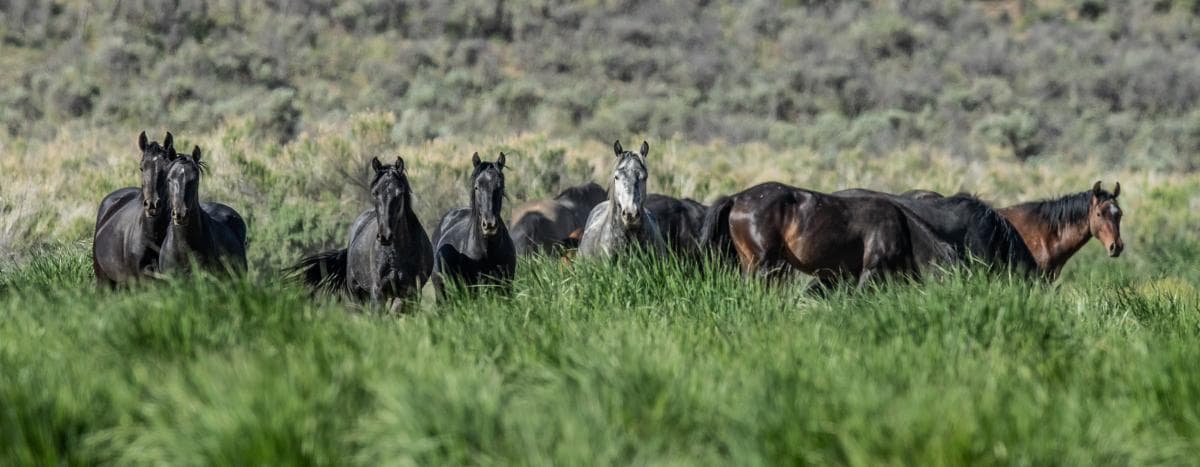
Photo by WilsonAxpe Photography
Call for Reform
TheBLM's actions have been criticized as a rejection of offers to find alternatives to overcrowding holding facilities. Humane solutions could include reducing removal numbers, relocating horses, and improving habitat resources. Pressure is mounting on theBLMto change its approach, with calls for oversight hearings on the Wild Horse and Burro Program.
Colorado, with its engaged public and political leadership, is poised to lead the way in holding theBLMaccountable for its management practices. The coming weeks will reveal whether the agency is ready to embrace reform.
Suzanne Roy is the executive director of the American Wild Horse Conservation (formerly American Wild Horse Campaign).
Subscribe to our newsletter: