
BLM's Ongoing Battle Against Wild Horses in Wyoming's Checkerboard
Wild Horse Management
Read time: Seven Minutes
Published: March 28, 2017
Written by:
AWHC Contributor
The ongoing struggle over the management of wild horses in Wyoming's Checkerboard region highlights a persistent conflict between the Bureau of Land Management (BLM) and wild horse advocates. TheBLMaims to reduce horse populations to appease ranchers, while advocates fight to protect these federally-protected animals.
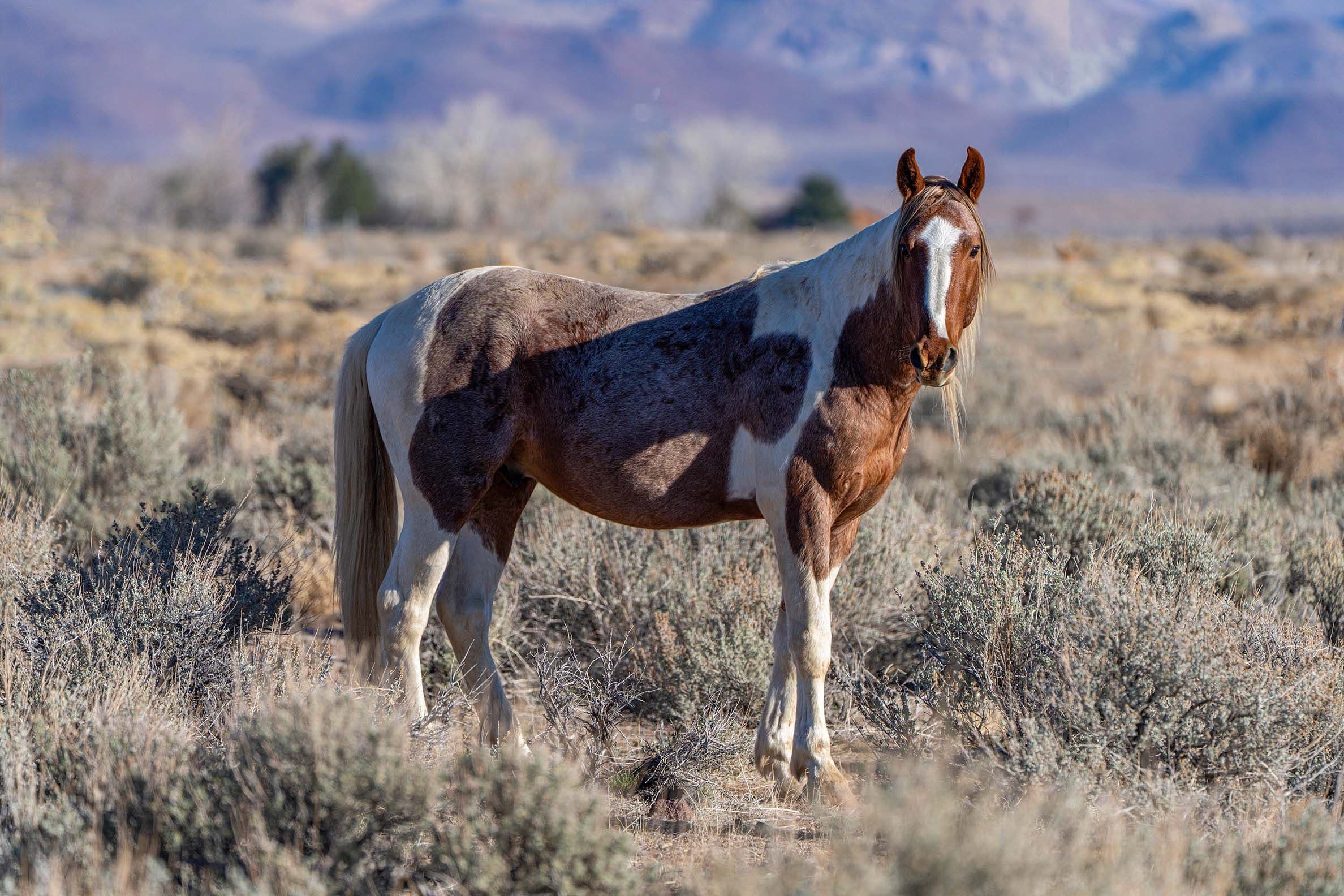
(March 28, 2017) The management of the wild horses on the Wyoming Checkerboard is a story about persistence. On the one hand, there’s the Bureau of Land Management (BLM) that’s determined to eliminate them to appease ranchers who want the land to graze their cattle. On the other hand, there are the wild horse advocates and most of the American public who are equally determined to keep these federally-protected wild horses on the 2.4 million acres where they belong.
The Wyoming Checkerboard is comprised of both public and private land in the southern part of the state. According to theBLM, about 2,600 wild horses live there on the fourHerd Management Areas(HMAs) – Great Divide Basin, Salt Wells Creek, Abode Town, and White Mountain. The Checkerboard horses make up about one third of the population in Wyoming, a state that promotes the presence of wild horses in its tourism ads, inviting visitors to “Roam Free.” (Seehttps://youtu.be/pb9zhD89bJQ)
But, if theBLMhas its way, most of these horses won’t be there much longer. This fall it’s planning yet another roundup on the Checkerboard that would bring the population down to 1,276 wild horses – or low Appropriate Management Levels (AMLs).
So why another roundup in the Wyoming Checkerboard when there’s roughly 1,037 acres of land for every wild horse who lives there now and when theBLMhas already removed 1,263 wild horses in a 2014 roundup?
Quite simply, persistence – persistence on the part of theBLMto pander to ranching interests, to avoid its responsibility to protect wild horses, and to violate multiple federal statutes in order to support welfare ranching, selling out not only the wild horses but also the American taxpayers who subsidize it.
In a recent Scoping Notice, theBLMhas presented its newest proposal to remove 1,029 more wild horses from the Wyoming Checkerboard as a “gather” to “comply with the 2013 Consent Decree Rock Springs Grazing Association v. Salazar.” Admittedly, it also acknowledges that this proposal is replacing a 2016 “gather” that was prevented by a Tenth District Court of Appeals ruling on the “2014 checkerboard removal activities” –meaning it was illegal.
But here’s the real heart of the problem…
Back in 2010, the Rock Springs Grazing Association (RSGA) decided to renege on a 1981 agreement that allowed a limited number of wild horses on private lands in the Checkerboard. So its members visited then Interior Secretary Sylvia Baca who advised them to sue the government as a strategy for obtaining funding fromCongressto roundup the horses. Ironically, theBLMis tasked with protecting wild horses and burros, and it falls under the auspices of the Department of the Interior.
Following Ms. Baca’s recommendation, the RSGA did indeed sue theBLMin 2011, demanding that wild horses be removed fromboth private andpublic landsin the Checkerboard.
TheBLM’s response…it gave the RSGA exactly what it wanted by signing a Consent Decree in 2013 that called for the permanent removal of wild horses from the Salt Wells and Great Divide Basin HMAs, permanently sterilizing all wild horses in the White Mountain HMA, and reducing by half the number of wild horses allowed to live in theAdobe Town HMA. So much for protecting wild horses in Wyoming!
Now theBLMis threatening to remove 1,029 more wild horses from the Checkerboard. Does it have other options? Most certainly. But here’s where theBLMis, well, persistent in pursuing a pattern of badpolicy.
- Instead of exploring on-the-range management for wild horses on the Wyoming checkerboard, such as implementing fertility control to regulate their population, negotiating land swaps to create contiguous habitat for them, or reducing allotments for livestock grazing, the BLM persistently pursues roundups and removals that have been proven to be costly, inhumane, and ineffective.
- Instead of prioritizing the interests of wild horses and American taxpayers, the BLM persistently makes decisions that clearly benefit a handful of cattle ranchers who believe that the private and public land in the Checkerboard belongs to them and who pay far less for grazing rights on public land than they would on private land.
- Allowing 255,000 cows and their calves to live on the Wyoming Checkerboard compared to only wild 1,276 horses.
And the list goes on.
Yet, persistence also plays another and bigger role in this story.
Remember the Tenth District Court of Appeals ruling on the “2014 checkerboard removal activities” that prevented the 2016 Checkerboard roundup? It was the result of a series of lawsuits filed by the American Wild Horse Conservation (formerly American Wild Horse Campaign) and our partners. Besides finding that theBLMviolated two federal laws – the Wild Free-Roaming Horses and Burros Act and Federal LandPolicyManagement Act – in its 2014 wild horse roundup, the Tenth District Court decided that the agency’s plan to round up 500 more horses from the Checkerboard was also illegal.
In fact, the American Wild Horse Conservation (formerly American Wild Horse Campaign) has consistently led the fight for all wild horses in Wyoming through our ongoinglitigationand significant victories in the courtroom.
For example, in 2016, the American Wild Horse Conservation (formerly American Wild Horse Campaign) and our partners filed another motion with the U.S. Court of Appeals Tenth District seeking to dismiss a lawsuit filed in a lower court by the State of Wyoming against theBLM. This time, the state sought the removal of hundreds of wild horses in the Antelope Hills, Crooks Mountain, Green Mountain, Lost Creek, Stewart Creek, Fifteenmile, and Little Colorado HMAs in order to reach low AMLs.
Once again, the appellate court ruled against the State of Wyoming, finding that the Wild Horse Act doesn’t define AMLs and that theBLMis “under no statutory duty to remove animals from the seven HMAs at issue.” According to Bill Eubanks of the public interest law firmMeyer, Glitzenstein and Eubankswhich represented the American Wild Horse Conservation (formerly American Wild Horse Campaign), “the decision had important implications for federal wild horse policy for decades to come” in that theBLMwas not obligated to remove wild horses but had “broad discretion to implement other management approaches.”
Equally important, the combined force of these landmark decisions is setting major legal precedents and successfully challenging cattle and sheep ranchers who want to treat public land as their own private land andBLM’s policies that favor welfare ranching over thousands of federally-protected wild horses, not just in Wyoming but across the West. These victories, along with your support, enable the American Wild Horse Conservation (formerly American Wild Horse Campaign) to continue the fight to keep wild horses on the Wyoming Checkerboard in this newest round with theBLMand cattle ranchers – and the next.
That’s called persistence.
Take Action Today for Wyoming's Wild Horses
Other related readings:
Major Victory for Wild Horses: Federal Appeals Court Tosses State of Wyoming’s Anti-Mustang Lawsuit
Landmark Appellate Court Decision Stops BLM Wyoming Wild Horse Wipeout
Subscribe to our newsletter: