
Building a Firewall for Wild Horses: AWHC's Ovariectomy Lawsuit
Press Releases
Read time: Six Minutes
Published: September 30, 2019
Written by:
AWHC Contributor
American Wild Horse Conservation (formerly American Wild Horse Campaign)is actively fighting against the Bureau of Land Management's (BLM) controversial ovariectomy via colpotomy experiments on wild mares. These procedures are deemed unscientific, inhumane, and dangerous, posing significant risks to the welfare of wild horses. This press release outlines our ongoing legal battle to protect these majestic animals.
(September 30, 2019) One of the more egregious plans the Bureau of Land Management (BLM) has released for “management” of wild horses is the ovariectomy via colpotomy experiments. This outdated procedure is a blind surgery in which a veterinarian inserts his arm into a mare's abdominal cavity through an incision in the vaginal wall, manually locates the ovaries, then twists, severs, and removes them using a rod-like tool with a chain on the end. The procedures are clearly unscientific, inhumane, and dangerous, and will result in pain, suffering, and potentially life-threatening complications for wild mares.
As soon as we got wind of theBLM’s plans for the mares from the Warm Springs Herd Management Area (HMA) in Oregon, we filed suit to protect the welfare interests of the wild mares and protect them from inhumane experimentation. Below is a brief history of our involvement and the most recent information we have on theBLM’s pursuit. With your support, we will never give up on these mares and will continue to fight theBLMin court.
2016
In 2016, theBLMplanned to conduct aseries of sterilization experimentson wild mares at the agency’s corral facility in Hines, Oregon. The experiments on 225 wild mares were set to be conducted by the staff of Oregon State University (OSU). The study implemented three sterilization techniques: (1) ovariectomy via colpotomy, (2) tubal ligation, and (3) hysteroscopically guided laser ablation of the oviduct papilla. A primary goal of theBLM’s plan was to determine the “social acceptability” of each type of sterilization procedure. Yet, theBLMrefused to allow any public observation of the procedures.
2018
In 2018, theBLMchose to move forward withsimilar sterilization experiments. However, this time the agency has chosen to only perform ovariectomy via colpotomy on wild mares at the agency’s corral facility in Hines, Oregon. The experiments on 100 wild mares were set to involve the staff of Colorado State University (CSU). However, after the close of the comment period on the EA, CSU withdrew from participation in the study. Without CSU, theBLMhad no plan to conduct welfare observations of the mares during the procedures. This is a critical component to aiding the agency in determining whether or not the procedures are humane as required of allBLM’s wild horse management under the WHA.
In contrast to its 2016 plan, theBLMallowed for limited public observation. However, the provisions that theBLMhas provided are extremely inadequate and still infringed on our First Amendment rights.
2019
TheBLMreleased yetanother EAin pursuit of the ovariectomy via colpotomy experiments. At this point, the mares have been in holding for roughly a year since the roundup and have had their foals in holding, meaning that none of the mares would be pregnant at the time of the procedures. Therefore, the major difference between the last 2018 EA and this one was the disclosure that mares would not be pregnant at the time of the experiments.
However, this seemingly small detail greatly impacted theBLM’s original purpose for the experiments in the first place. The experiments were meant to test the feasibility, morbidity, and mortality of the ovariectomy via colpotomy procedure in mares recently removed from the range so that theBLMcould determine if this procedure was a viable management tool. As we know, mares that are rounded up from the range are usually in some stage of pregnancy. Therefore, performing the experiments on open, or non-pregnant mares, would not accomplish the goals of the agency to determine whether they could implement this procedure in the field - where the mares are in some stage of pregnancy.
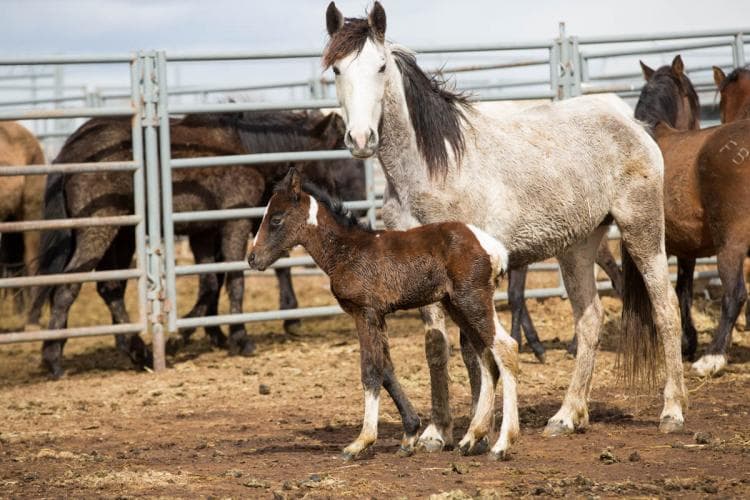
Further, the EA was devoid of any consideration for what effects the procedure would have on young, nursing foals and their mothers when the mothers undergo such an invasive and inhumane procedure.
Finally, the 2019 EA made no attempt to accommodate better viewing or observation and aftercare for the mares. TheBLMinstead asked commenters to explicitly state what they wanted in terms of observation. Even though our granted preliminary injunction (PI) motion from the 2018 EA made these needs clear, we explicitly stated what the agency should do in ourcommentson this EA.
Our Lawsuit Now
After defeating the 2016 plan in court with a PI, we again took to the courts in response to the 2018 plans. AWHC joined forces withThe Cloud Foundationand Ginger Kathrens for this lawsuit, and now we are also joined by theAnimal Welfare Instituteand Carol Walker, a wild horse photographer (collectively the Plaintiffs). On September 21, 2018, Plaintiffs filed acomplaintand PI in the Federal District Court of Oregon to challenge theBLM’s decision to seriously limit public access to observe and document these sterilization experiments.
The judgegrantedthe motion for a Preliminary Injunction on two of the three counts raised in our motion. This action halted the experiments, which were scheduled to begin November 5, 2018, and the government later abandoned the experiments as a result. Shortly after this development, appropriations lapsed and the federal government shutdown. The government filed amotionto stay (pause) the case until the government was open again, and the court granted the motion.
When the government reopened, the government filed a motion to dismiss the case. However, around the same time, theBLMreleased the 2019 EA. Since this EA implemented none of the observation considerations which granted us our PI, we decided to file amotionfor a stay until the final decision was released. If the agency moved forward with a substantially similar plan like the one which the judge had just reviewed, we would want to notify the court of this event. The judge granted our motion to stay until theBLMreleases its final decision. This means that our lawsuit remains on pause until we have the chance to see what, if anything, theBLMhas changed in the final 2019 EA decision.
In the meantime, both parties are providing court-ordered updates on the status of the decision and the case. As of today, theBLMhas not released a final decision on the 2019 EA. The next update is due in November 2019.
Please consider making a contribution towards our critical legal defense fund.
Subscribe to our newsletter: