
Can Birth Control Save Our Wild Horses?
Fertility Control
Read time: Six Minutes
Published: November 1, 2016
Written by:
AWHC Contributor
Wild horses are an iconic symbol of the American West, but their growing populations pose challenges for land management and conservation efforts. Contraceptive vaccines are emerging as a potential solution to control their numbers humanely. This article explores the use of birth control inwild horse management, the debate surrounding its implementation, and the efforts of organizations like the American Wild Horse Conservation (formerly American Wild Horse Campaign).
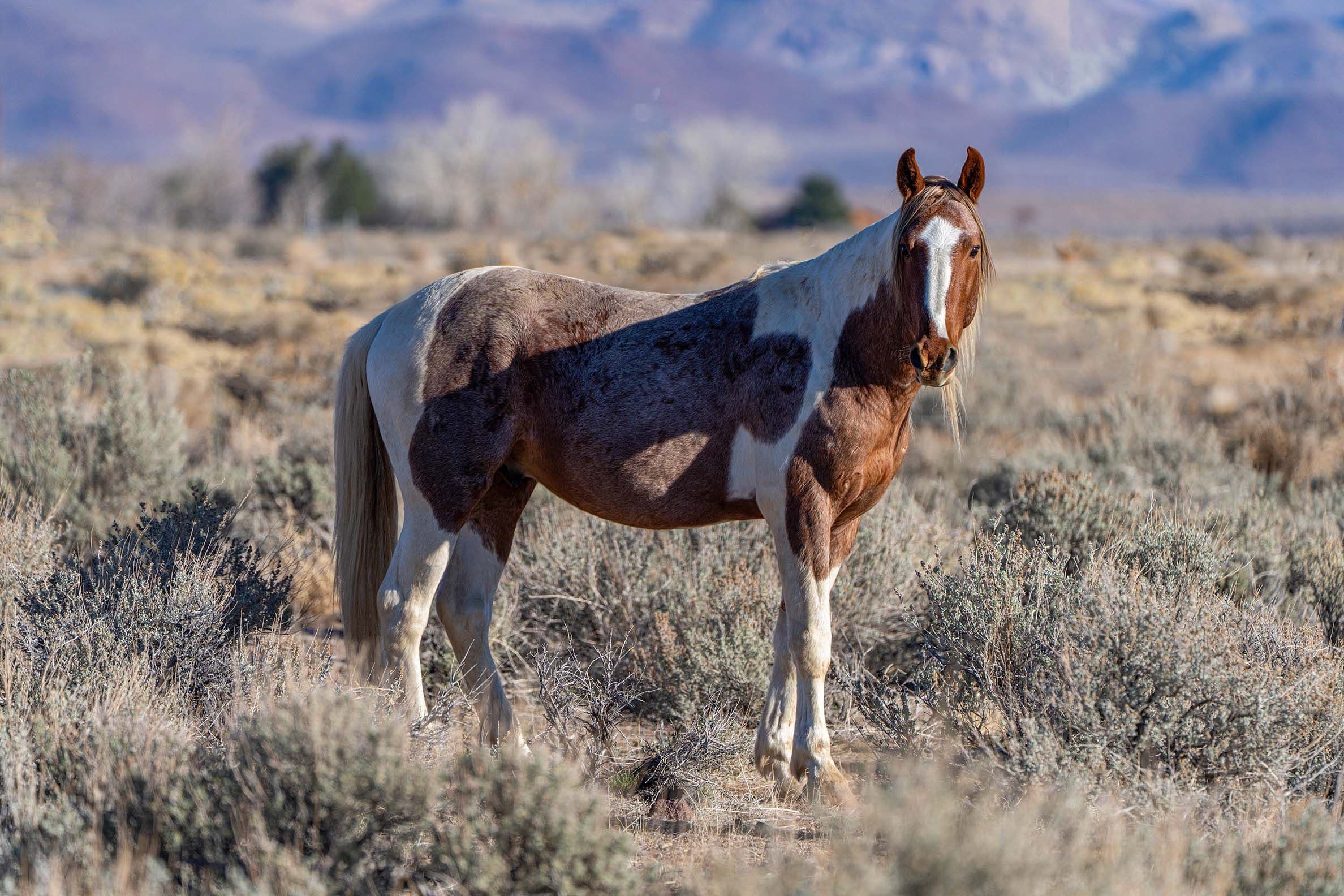
When Nancy Kilian, a self-describedhorselover, spotted a brown-and-white pinto mare standing among the sagebrush and juniper trees near Carson City,Nevada, a couple of weeks ago, she didn’t hesitate.
She loaded her darting rifle, aimed at the female’s rump, and fired.
“She jumped a bit,” Kilian recalled, “because it stings, but settled down. I knew I was doing her a favor.”
The favor: Injecting the one-year-old animal (whom Kilian recognized from a photo) with a contraceptive vaccine that triggers her immune system to reject fertilization. Kilian or another member of the American Wild Horse Conservation (formerly American Wild Horse Preservation), a California-based nonprofit, will give the mare a booster in January via the same method.
Horse birth controlis a key strategy to better manage wild horses on rangelands throughout the western U.S. Descended from domesticated animals that escaped or were released from captivity, wild horses are technically “feral”—the term used to describe the offspring of any domesticated species that people no longer tend.
Mustangsare a type of wild horse descended from Spanish horses brought to the U.S. centuries ago, according toD. Phillip Sponenberg, a professor of pathology and genetics at Virginia Tech.Only a few populations of these small, athletic animals survive—and even most of these have interbred to some degree with other European horses. (Smarter than you think: Read how horses have consciousness.)
The Bureau of Land Management protects wild horses and burros in all 10 western states they call home. And with very few predators, their numbers are booming. Some 77,000 of the animals now live onpublic landsthat theBLMsays can support only 27,000. And manypopulations are growing at 20 percent or more a year, putting extreme pressure on rangelands—and in some cases leading to starvation.
“They have to be managed, so that there’s enough food and water to go around,” says Jason Lutterman, a spokesperson with theBLM’sNational Wild Horse and Burro Program, which works with state agencies and nonprofits to care for the animals.
Tough Choices
To keep wild horse numbers in check, federal and state agencies mostly round them up and encourage people to adopt them. But such guardians are harder to find these days, leading theBLMto spend some $49 million a year to house 46,000 horses in 60 private ranches, corrals, and feedlots.
Recently, after touringpublic landsseverely damaged by organizing, agovernment advisory board recommended the BLM consider euthanasia for some horses. The suggestion, whichbrought a storm of protest from the publicand animal-welfare organizations, has since been shelved.
In September, theBLMeliminated another possible tool: sterilization. The agency had planned to experimentally sterilize 200 wild mares at a facility in Oregon, but halted the study afterwild horse advocates filed lawsuits to stop the research—or to at least allow the public and media to observe and record it.
That leaves theBLMwith few management options other than adoption andfertility control, both methods that the public mostly support. (SeeNational Geographic readers' photos of horses.)
Single-Shot Solution?
The latter could be “very, very successful”—particularly if it only takes one injection, saysJason Bruemmer, a reproductive physiologist at Colorado State University in Fort Collins,whose research is supported by the BLM.
Currently, the most commonly used vaccine, known by its abbreviationPZP(the one Kilian delivered to the Nevada mare) requires an annual booster—and thus requires more work for wild horse managers, including the American Wild Horse Conservation (formerly American Wild Horse Preservation), whose members help track mare vaccinations.
Making their jobs more difficult, mares can come into estrus a mere six days after giving birth.
They are "remarkably efficient," says Bruemmer, "but that reproductive efficiency” is also what "causes their problems." (Read about wild horses inNational Geographicmagazine.)
So Bruemmer and his colleague, Douglas Eckery, are investigating another contraceptive vaccine, Gonocon, that may safely and permanently sterilize a mare.
Earlier this year, the scientists inoculated ten of their 30 study animals. During the breeding season, they allowed stallions to visit the mares. Bruemmer won’t give details before the two-year study is over, but he does say “it looks very promising.”
Tough Choices
Some wild horse advocates worry that contraceptives may alter the horses’ behaviors and change their communities.
For instance,Deniz Bolbol, the preservation campaign's communications director, is against sterilization and the Gonacon vaccine, which affects a mare's hormonal system. She says these methods "mess up their hormones so that they are no longer wild. They are just pasture horses."
Anne Novak, director of the nonprofitProtect Mustangsin Berkeley, California, says her group is "against any kind of experimenting on wild horses, including birth control experiments."
"Wild horses are protected by law, and birth control experiments don't jibe with the law."
Novak worries that stallions may chase non-reproducing females out of their herd—though there's no definitive evidence that this happens.
Yet many wild horse managers and advocates, such as Bruemmer, believe easily administered contraceptive vaccine would be a godsend.
“We don’t want to interfere with the horses’ societies,” he says, “but we also don’t want to see the horses overpopulating the range, or degrading their habitat—or starving.” (See more photos of wild horses.)
To prevent that scenario, Amanda McAdams, a forest supervisor inModoc National Forest, California, incorporates contraceptives into her management approach.
McAdams recently oversaw a round-up of 290 horses from a herd of 2,246 that roam 232,000 acres. Research shows the land—some federal, some tribal, some private—can support between 206 and 422 horses, which come in a rainbow of colors—red roans, bay roans, dark grays, sorrels, and blacks.
Healthy and Free
“Their population doubled just since 2012. That kind of growth is scary to us. We love having wild horses here; they are amazing to see," she says.
"But we also need a management strategy for them that works. And it shouldn’t be just a hard winter.”
Animals five years and younger will be sent to theBLM’sLitchfield Wild Horse and Burro Facilityin California for adoption, according to McAdams. Older horses will be returned to the national forest after injecting females with thePZPcontraceptive.
“Some people say the contraceptive makes them less wild,” adds Kilian.
“I see it as keeping them healthy and free.”
Originally posted by National Geographic
Subscribe to our newsletter: