
>
stories
>
feds plan to remove north dakotas only wild horse herd from theodore roosevelt national park 8038
Feds Plan to Remove North Dakota’s Only Wild Horse Herd from Theodore Roosevelt National Park
Wild Horse Management
Read time: Four Minutes
Published: January 13, 2023
Written by:
AWHC Contributor
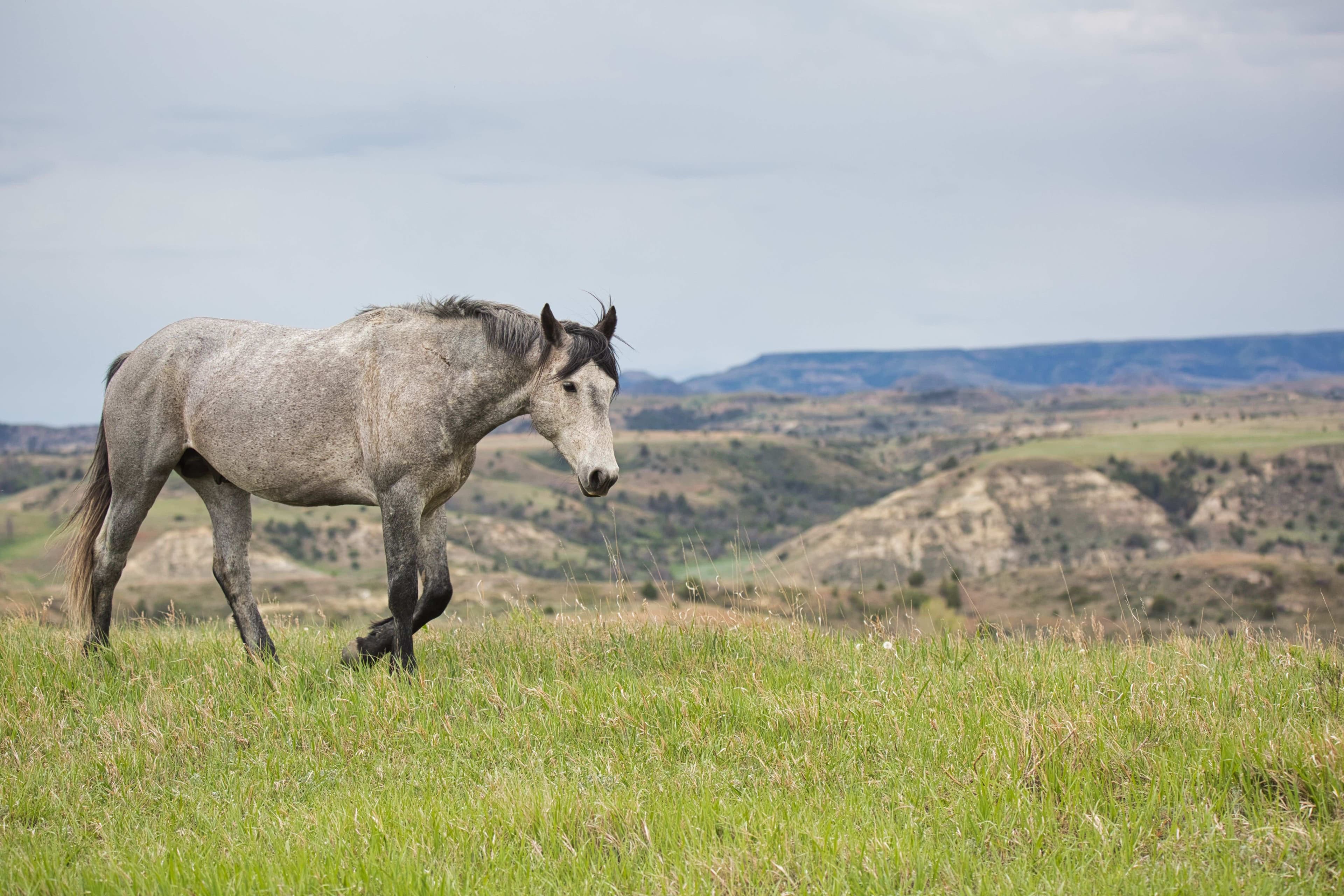
Theodore Roosevelt National Park (TRNP) plans to remove its wild horse herd, citing alignment withlivestockmanagement policies. This decision has sparked significant debate over conservation and tourism impacts.
On January 12, 2023, the TRNP held a virtual public scoping meeting regarding its proposedLivestockManagement Plan. The message was clear: wild horses have no place in the park named after America’s Conservation President.
About 160 participants attended the presentation, which covered the history oflivestockin the park, a review of three proposed management plan alternatives, and a lengthy Q&A session.
Panelists included Angie Richman, Superintendent at TRNP; Blake McCann, Director of Resource Management andScienceat TRNP; Maureen McGee-Ballinger, Deputy Superintendent at TRNP; and Christine Gabriel, Regional Environmental Coordinator.
Currently, 186 horses and 12 longhorn cattle reside in two units of the 70,000-acre park. The three alternatives are: maintaining the 1978 Environmental Assessment and 1970 Management Plan allowing 35-60 horses and up to 12 cattle; expedited elimination of all horses and cattle; and phased elimination of all horses and cattle.
Throughout the meeting, the panel reiterated TRNP’s position that wild horses are nonnativelivestock, not native wildlife, emphasizing alignment with park policies.
Mr. McCann stated that natural history records and genetic studies show wild horses come from domestic stock, aligning with TRNP’slivestockdefinition.
(Never mind that current DNA and mitochondrial evidence supports that wild horses are a reintroduced native species, and TRNP has not shown why it classifies the horses aslivestockrather than wildlife.)
Ms. McGee-Ballinger emphasized that previous park enablinglegislationdoesn’t addresslivestock, and there’s no requirement allowinglivestockat TRNP, making horse maintenance misaligned with policy.
(Never mind that other national parks, like Assateague Island in Maryland and Shackleford Banks in North Carolina, maintain healthy wild horse herds. The National Park Service calls the Assateague herd a “cultural resource,” and the Shackleford herd is protected after federallegislationwas amended—a move that could save TR wild horses.)
Ms. Richman concluded the alignment discussion by stating that although the horses were classified as a historic demonstration herd since the 1970s, parklegislationand the Organic Act of 1916 show no clear basis to supportlivestock. She added that TRNP’s charge is to memorialize Mr. Roosevelt’s conservation legacy, not his ranching legacy, aiming for realignment with native wildlife and prairie ecosystems.
(Never mind that wild horses have roamed the Badlands of Theodore Roosevelt National Park since before its creation, and Mr. Roosevelt frequently wrote about their beauty, history, and resilience.)
Unfortunately, there was no discussion on how keeping wild horses in TRNP aligns with the will of North Dakota residents, businesses, or the American people.
TRNP responses to participant questions included:
- What is the fate of removed horses?TRNP would offer tribes the first opportunity to take the horses, with nonprofits next. Remaining horses would be sold on the GSA auction site. TRNP aims to find good homes for all removed horses but cannot guarantee their outcome once they leave the park. At least 140 horses are estimated to be removed.
- How will horse removal impact tourism at TRNP and local businesses?TRNP did not acknowledge that viewing wild horses is a main attraction. Instead, it emphasized other TRNP attractions, including the Little Missouri River, native wildlife like bison and bighorn sheep, and diverse habitats. The Environmental Assessment will examine economic impacts.
- Is there data on wild horses' detrimental effects on other wildlife in TRNP?TRNP cited evidence in published literature showing livestock harms native ecosystems but provided no TRNP-specific information. It stated livestock removal is necessary for more forage for native wildlife and their adaptability, especially with climate change.
- Could horses be moved from the South Unit to the North Unit of TRNP?No. TRNP stated moving livestock wouldn’t address planning and federal regulation requirements.
A transcript of the meeting is available athttps://parkplanning.nps.gov/LP
The deadline for Scoping Notice comments is January 31st. Comments and supporting documentation can be submitted online through the park's Planning, Environment, and Public Comment (PEPC) website athttps://parkplanning.nps.gov/LPor sent to:
SuperintendentTheodore Roosevelt National ParkP.O. Box 7Medora, N.D., 58645
You can also take action here.
Subscribe to our newsletter: