
Future of Horses at Bartlesville, OK Long-term Holding Facility
Wild Horse Management
Read time: Six Minutes
Published: August 22, 2017
Written by:
AWHC Contributor
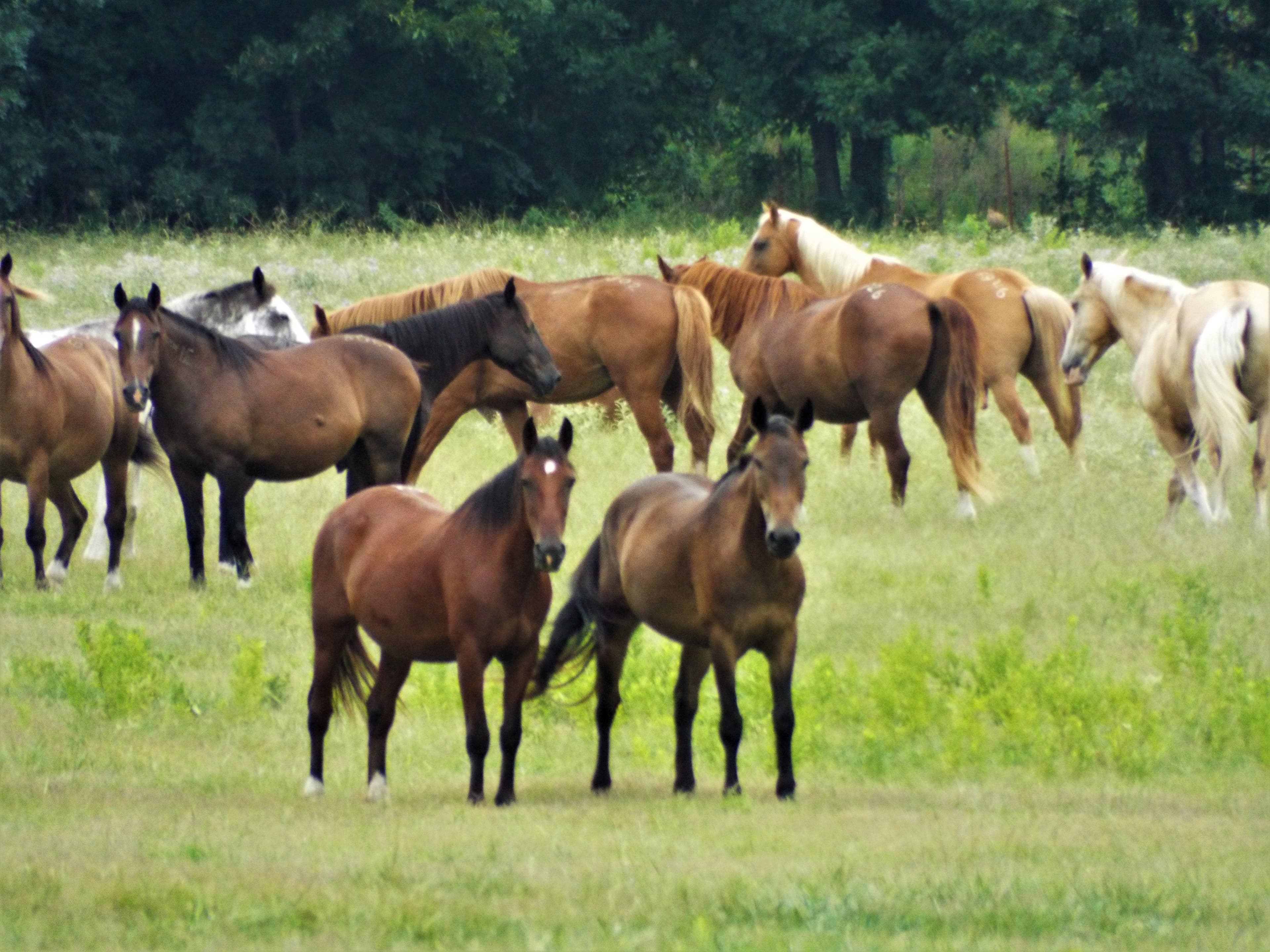
About 45 miles north of Tulsa in Bartlesville, Oklahoma, lies the Hughes Ranch, where thousands of horses graze on its 12,000 acres. Although horse ranches in the Sooner state are a common sight, the Hughes Ranch is somewhat unique. It’s home to approximately 2,000 previously wild horses who were rounded up and removed frompublic landsacross the west by the Bureau of Land Management (BLM) and shipped there to live out their lives.
Sadly, though, their lives may come to an end in the very near future if theBLMhas its way andCongressapproves its request in the 2018 FY budget to kill or send to slaughter up to 100,000 “excess” horses and burros on the range and in captivity.
Last Saturday, theBLMoffered the public a rare opportunity to visit one of its long-term holding facilities, which are otherwise closed to the public. These facilities are owned by private ranchers who contract with the federal government to provide habitat and care for about 32,000 unadopted or unsold wild horses.
This year’s public tour was located at the Hughes Ranch, one of the first of 30 long-term holding facilities that house capturedmustangstoday. Almost 300 people filled two large luxury buses for morning and afternoon trips that included stops to see horses as well as a visit to the America’s Mustang “Virtual Reality” trailer.
As Robert Hughes, who owns and operates the ranch, explained, the Hughes family opened the facility in 1986. Of the 2,000 residential horses, most are geldings – except for a few mares – who are divided into 10 groups of 150 to 200 horses. To prevent overgrazing, they’re rotated around the ranch’s 37 pastures every month or so.
At the first stop, just after entering the ranch, about 160 horses – primarily bays and sorrels with a few palominos, buckskins, and greys mixed in – watched and waited as visitors climbed out of the buses to set up cameras and arrange themselves to get the best view. We were told that the horses often approach people, but this day they were wary and kept their distance for quite a while, continuing to watch before eventually galloping up and over a hill, then out of sight into a stand of live oak trees.
Like the horses at the other off-range pastures in the Midwest and Great Plains, those at the Hughes Ranch are older – on average 15 to 20 years old. Some have lived past 30. Mr. Hughes estimated the mortality rate is five to six percent annually. When space becomes available, more horses are brought to the ranch.
From a distance, admittedly, the horses look in good shape. Their coats are shiny, especially in the morning sunlight, and a substantial amount of flesh covers their sides and rumps. Like all horses, too, they emit a special beauty and grace.
The pastures are lush, they have access to three permanent creeks, and during the winter, they’re fed Fescue-Bermuda hay and alfalfa grown on the property to maintain them.
Mr. Hughes explained that the horses receive no veterinary or hoof care after they arrive at the ranch. He said that rocks under the grass and other forage help keep their hooves worn down. We were unable to get close enough to the horses to independently verify the condition of their hooves. As theBLMstates, the goal is to largely treat the horses as if they’rein the wild– to leave them to themselves and allow them to roam freely.
Important to remember, however, is that these horses are notin the wild. As a few people on the tour commented, they’re geldings living in large groups of other geldings – not in small herds or bands or families with a stallion, mares, and an assortment of foals. It’s not clear who the leader is, and ultimately, they’re confined by fences and limited to this private land instead of endless stretches of public rangeland.
During the tour, Debbie Collins, a staff member with the Bureau of Land Management/NationalWild Horse and Burro Program, said the agency pays ranchers about $1.85 a day for each horse kept in long-term holding facilities, such as the Hughes Ranch. Once a year, a compliance officer from theBLMis supposed to visit and check to be sure the horses are being appropriately cared for. Although federal contracts usually are limited to 5 years, those for these facilities are extended to 10 years to ensure continuity.
According to theBLMwebsite, as of June 2017, 43,816 horses and 923 burros are being fed and cared for in 30 long-term holding facilities or pastures, 3 ecosanctuaries, and 27 short-term holding corrals at a cost of $50 million a year – 63% of last year’s $80 million budget. In comparison, theBLMused less than 1% of its 2016 budget to treat only 467 mares withfertility controlwhich has a 30-year history of being safe and effective in suppressing population growth. (Last year, the American Wild Horse Conservation (formerly American Wild Horse Campaign) treated about the same number of mares on the Virginia Range in Nevada with one staff member and six dedicated volunteers!)
The second stop, and as it turns out the last, was at the America’s Mustang “Virtual Reality” Trailer where fortunately another large group of horses grazed nearby. Inside the trailer, sponsored by the Mustang Heritage Foundation, a headset offered us the chance to take a four-minute virtual tour of a Herd Management Area, ironically not to educate us about the horses living there but to show the destruction that they cause to the range.
WhenBLMstaff was asked what will happen to these horses on the Hughes Ranch ifCongressallows the current federal protection to be removed, no clear answer was forthcoming.
Currently, theBLMestimates about 72,000 wild horses and burros are sharing the public rangelands in 10 Western states with more than 1 millionlivestockwho are grazing at an enormous expense to American taxpayers and being allotted a disproportionate share of resources. In the next few months alone, the agency is planning to remove more than 10,000 horses, knowing these animals may be killed or sold for slaughter.
Please take action to save these iconic symbols of our history and heritage, whether they’re on the range or in holding facilities, such as the Hughes Ranch, by clicking here.
Subscribe to our newsletter: