
Nation’s Largest-Ever Wild Horse Roundup Ends, Halving Wyoming’s Wild Horse Population
Press Releases
Read time: Four Minutes
Published: January 19, 2022
Written by:
amelia perrin
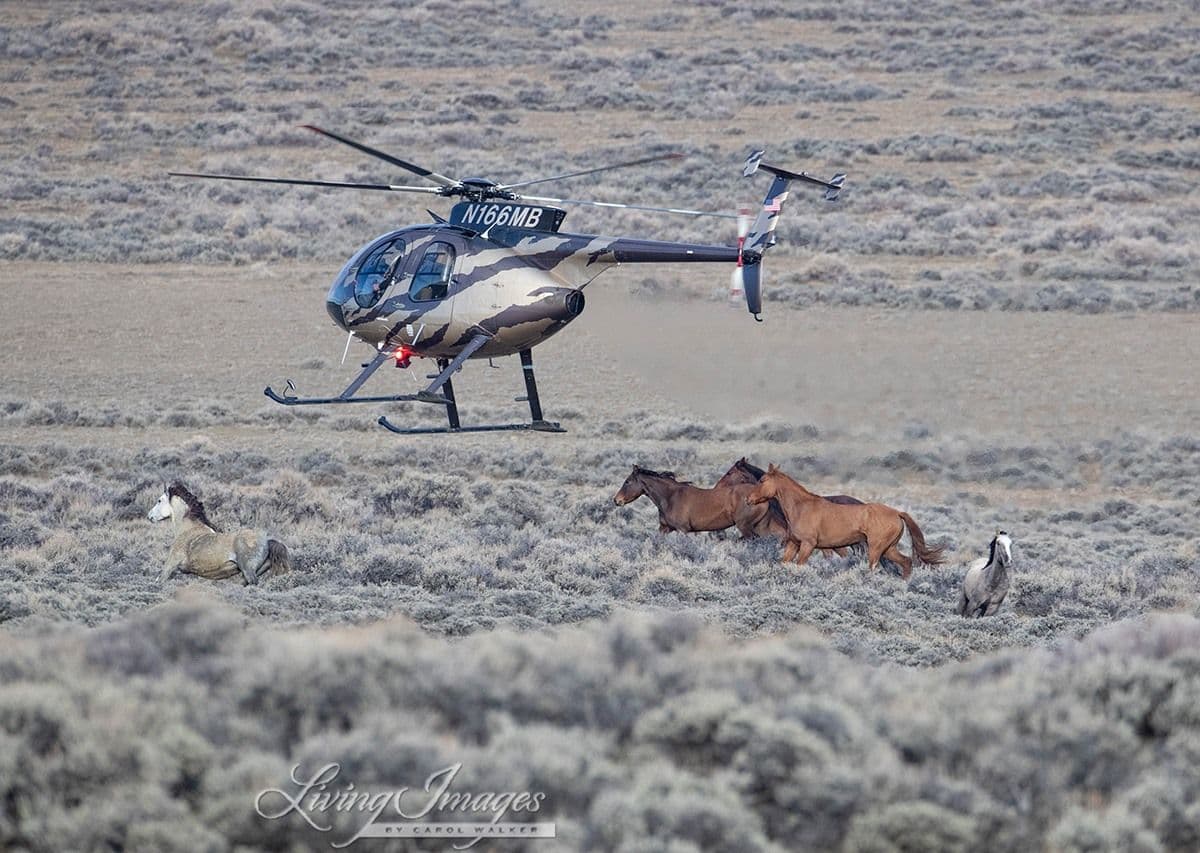
4,158 wild horses captured; 37 dead
ROCK SPRINGS, WYOMING (Jan 19, 2022)—On Monday, the largest federal wild horse roundup came to an end. Launched on October 7, 2021, and conducted by the U.S. Bureau of Land Management (BLM) across a 3.4 million-acre habitat area known as the “Wyoming Checkerboard,” the massive helicopter capture operationresulted in the roundupof 4,158 wild horses, the permanent removal of 3,650, and the deaths of 37 of these iconic animals. While theBLMattributed 27 of the deaths to “pre-existing conditions,” the American Wild Horse Conservation (formerly American Wild Horse Campaign) noted that the vast majority of the horses were “euthanized” for non-life-threatening conditions such as “swayback” or clubbed feet.
The captured wild horses will be sent toBLM-operated holding facilities in Rock Springs and Cañon City, while the remainder will be sent to a newly constructed Concentrated Animal Feed Operation (CAFO) in Wheatland, where they will be confined to feedlot pens that provide just 700 square feet per horse. Many of these horses willend up in the slaughter pipelineas a result of theBLM’s Adoption Incentive Program.
This roundup was rife with controversies, fromalleged first amendment issuesto allegedanimal welfare violations.
With the completion of this operation, just 1,550 wild horses will remain wild — a density of 1 horse per 2,217 acres. Taxpayers will pay up to $170 million in capture and holding costs for the horses who will be replaced on the landscape by privatelivestockgrazing, an activity that taxpayers also subsidize.
“TheBLM’s reckless assault on Wyoming’s wild horses was unnecessary, inhumane and a colossal waste of our tax dollars,” said Suzane Roy, Executive Director of AWHC. “It’s left the magnificent Red Desert landscape devoid of these majestic, federally-protected animals and feedlot pens crammed full of these formerly free-roaming animals. This is no way to manage America’s cherished wild mustangs, and it’s long past time for theBLMto stop the roundups and implement humane, scientific management withfertility control.”
The National Academy of Sciences recommended humane, reversible fertility control vaccines as a more sustainable management method for wild horses and burros underBLMmanagement. Last year, both the USHouse of Representativesandthe Senateincluded language in the Fiscal Year 2022 appropriations bills that would revert $11 million of theBLM’s funding away from the costly and unscientific roundup practices towards the implementation of a robust fertility control vaccine program.
“Congress recognized the importance ofscienceand the will of the American people by taking steps to ensure our wild horses stay wild,” Roy continued. “It’s time for theBLMto do the same.”
More than 90 percent of forage resources on the public lands in the Checkerboard are allocated to private livestock grazing, with wild horses and wildlife left to survive on the scraps. Numerous environmental organizations have recently called out theBLMfor its biased treatment of wild horses, which is “inconsistent with both the letter and spirit of the 1971 Wild and Free-Roaming Horse and Burro Act,” according to the 3.7 million-memberSierra Club.Other groups, such as theSierra Club Colorado,Public Employees for Environmental Responsibility, andWestern Watersheds Project, have called outBLMfor scapegoating wild horses for ecological damage caused by livestock grazing.
About the American Wild Horse Conservation
TheAmerican Wild Horse Conservation(AWHC) is the nation's leading wild horse protection organization, with more than 700,000 supporters and followers nationwide. AWHC is dedicated to preserving the American wild horse and burros in viable, free-roaming herds for generations to come, as part of our national heritage. In addition to advocating for the protection and preservation of America's wild herds, AWHC implements the largest wild horsefertility controlprogram in the world through a partnership with the State of Nevada for wild horses that live in the Virginia Range near Reno.
###
Photo by Carol Walker ofLiving Images by Carol Walker
Subscribe to our newsletter: