
The President's Budget: Implications for Wild Horses
Legislation
Read time: Four Minutes
Published: February 19, 2020
Written by:
AWHC Contributor
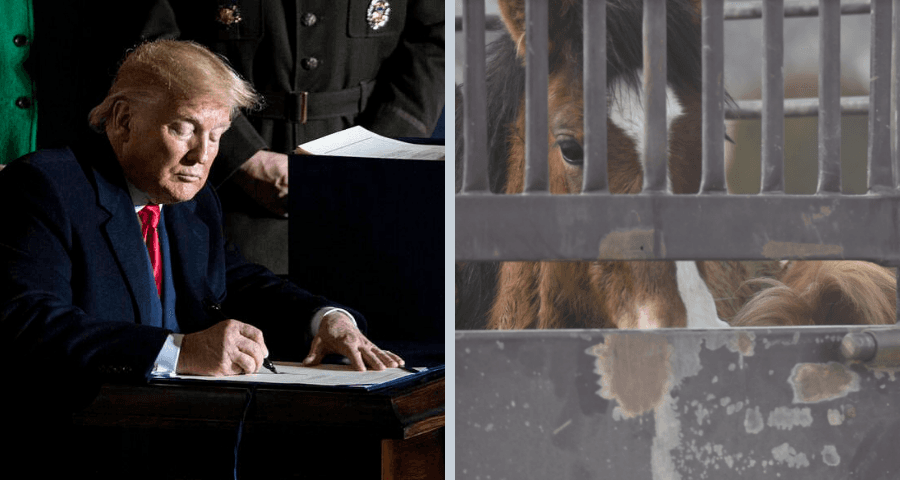
February 13, 2020- This past December,Congressauthorized a 25% ($21 million) increase for the Bureau of Land Management’s (BLM) Wild Horse and Burro program. Now, the Administration is asking Congress to approve an additional 15% ($15.3 million) budget increase for the program, as theBLMprepares to accelerate the roundup and removal of tens of thousands of wild horses.
What’s At Stake
The Acting Director of theBLMreferred to wild horses and burros as an “existential threat” topublic landsand is planning to use the Bureau’s funds to round up wild horses and burros in unprecedented numbers, with as many as 20,000 at risk of being removed this year alone.
Greatest Threat in Decades
We cannot stress this enough: We are talking about the greatest threat to wild horses in decades. It is critical to remember that theBLMis not considering reducing the number of privately owned livestock in these areas, despite these animals vastly outnumbering horses and burros on public land and costing taxpayers as much as $500 million in subsidies for the below-market grazing fees thatpublic landsranchers pay.
For reference, there are anywhere from 700,000 to 1,000,000 cow/calf pairs onpublic landscompared to the 88,000 federally-protected wild horses and burros (who share this land with thelivestock). Make no mistake about it, this isn’t a coincidence either -- It’s the result of intense lobbying on behalf of thelivestockindustry.
Bad Policy And A Broken Program
TheBLMcontinues to impose extreme limits on wild horse population numbers onpublic landsthroughout the West that have no basis in science. Their method of calculating these limits is not transparent to the public nor wildlife researchers and experts.
Additionally, theBLMis championing the use of inhumane and ineffective population growth suppression methods that focus on the castration of wild stallions and the risky, cruel, and invasive surgical practice known as ovariectomy, whereby a mare’s ovaries are manually severed and removed in an invasive and outdated surgical procedure.
The National Academy of Sciences warned againstBLM’s use of ovariectomies on wild mares due to the risk of hemorrhage and infection. Castrating stallions would cause a loss of testosterone, which drives the natural behaviors necessary to maintain social organization and survive in the wild.
BLMis not only charging ahead with surgical sterilization, but the budget indicates that the agency intends to use the appropriations process to amend the Wild Horse and Burro Act to explicitly authorize these surgeries.
Public Opposition
It’s also critically important to remember that the vast majority of Americans, of all political backgrounds, are opposed to mass roundups and these surgical procedures.
Another Way to Dump Horses?
While the President’s budget does recognize that the slaughter of America’s wild horses and burros is unacceptable toCongressand the public, we have grave concerns about the request for legislative language to expand the transfer authority of wild horses and burros to tribal entities.
American Wild Horse Conservation (formerly American Wild Horse Campaign) sees this as another way for the agency to take steps to reduce numbers of wild horses through policies that make it easier to move horses out of holding, strip them of their federal protection, and send them to destinations where their welfare will be impossible to ensure.
A Better Way
Here at American Wild Horse Conservation (formerly American Wild Horse Campaign), we’re proving that there is a humane and cost-effective way to keep wild horses and burros onpublic landsand end the roundup and warehousing of these wild animals in holding pens.
On the Virginia Range in Nevada, our team is operating the world’s largest humane management program of wild horses and burros. By utilizing a very affordable vaccine, known as PZP, our team has treated more mares in 10 months than theBLMdid last year. Each vaccine costs as little as $30 per year.
The President’s budget request is just that: a request. This means we have the chance to work with leaders inCongressto oversee theBLM’s Wild Horse and Burro Program, demand theBLMabandon the practices that are not supported by science or the American public, and promote effective and safe alternatives that our team has demonstrated work.
Over the last three years, working together, we’ve beat back multiple attempts to legalize the slaughter of wild horses and burros by convincingCongressthat the American people will not stand for this lethal and brutally inhumane option. Together, we can meet this newest and most serious threat to the future of America’s wild herds.
Wild horses and burros don’t have a voice. When you donate to AWHC, you give these precious animals more than a voice -- You give them a fighting chance.
Subscribe to our newsletter: