
Understanding Emergency Roundups for Wild Horses and Burros
Roundups
Read time: Six Minutes
Published: August 10, 2021
Written by:
AWHC Contributor
Understanding EmergencyRoundupsfor Wild Horses and Burros
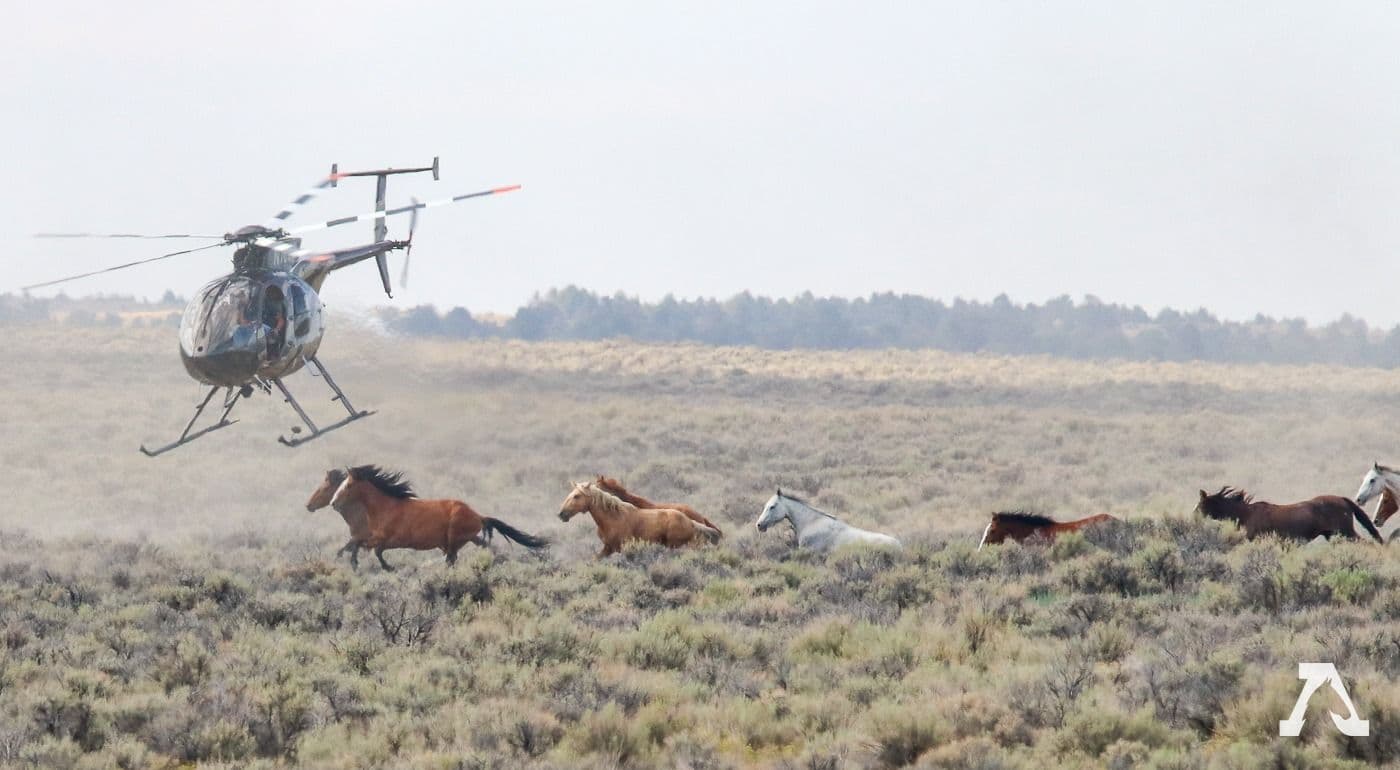
(August 10, 2021) TheBLMrecentlyannouncedthat it will conduct “emergency” actions to round up and permanently remove more than 6,000 “drought-stricken” wild horses and burros from Western public lands. The planned action will boost the total number of animals targeted for removal this summer and fall to nearly 10,000. Emergency action by the agency has already led to the removal of 1,200 animals all while permitting private, taxpayer-subsidizedlivestockto continue to graze in the same areas.
What is an emergency action and who authorizes it?
According to theBLM’s Handbook, Section 4.7.2, an “emergency” is generally an unexpected event that threatens the health and welfare of wild horses and burros and/or their habitat. Such emergencies are things like fire or disease. In these cases, immediate action is usually required. Once it is determined there is an emergency, the decision-maker must contact theBLM’s Washington D.C. Office, Division of Planning and SciencePolicy(WO-210) to outline subsequent actions theBLMplans to take.
Usually,BLMwild horses or burro management actions must go through a formal National Environmental Policy Act (NEPA) process that requires the agency to consider the impacts of its proposed action to the environment. In the case of an emergency though,BLMhas other options. If there is not already a NEPA plan in place, like an Environmental Assessment (EA), then theBLM’s NEPA Handbook, Section 2.3, provides “alternative arrangements” that may be established forBLMto comply with NEPA. Alternative arrangements do not waive the requirement to comply with NEPA, but establish an alternative means for compliance.
If timeframes permit, ideallyBLMshould complete a NEPA plan prior to removing any wild horses or burros. If this is not possible, theBLM’s emergency actions should be documented and then a report should be prepared after resolution of the problem. Also, the emergency actions should only address the emergency. IfBLMwants to take further action, like applyingfertility controlin an HMA with no NEPA plan for example, then it must undertake a NEPA process in order to take that further action.
Where is this happening?
In the final months of Fiscal Year 2021 (which ends September 30th), we are seeing theBLMuse the “emergency” designation across the West as an excuse to round up and remove more wild horses and burros from their homes on federalpublic lands.
For example, a very large emergency roundup is underway in the Antelope Complex in Nevada. Here, theBLMreleased a final NEPAdecisionback in 2017 to remove approximately 4,894-5,256 wild horses from the Antelope Complex in order to achieve the unscientific “Appropriate” Management Level (AML) of 427-789 wild horses. Now, theBLMis implementing this decision with the designation of an “emergency” action and is in the process of removing about 2,200 wild horses from their home on public lands.
However, while theBLMclaims that there is currently not enough forage and/or water in the Complex to sustain the wild horse population, at the same time theBLMcontinues to authorize thousands of cattle and sheep to graze in the Complex.
Did you know that BLM has the authority to close HMAs to livestock grazing?
Federal regulation 43 C.F.R. § 4710.5 authorizes theBLMto “close appropriate areas of the public lands to grazing use by all or a particular kind oflivestock. . . [i]f necessary to provide habitat for wild horses or burros, to implement herd management actions, or to protect wild horses or burros from disease, harassment or injury.” In the past,BLMhas claimed that this regulation can only be utilized in emergency situations, yet nothing in the regulation restricts its use to emergencies. However, with the agency’s announcement that emergency conditions are necessitating the removal of thousands of wild horses and burros from their federally designated habitat, it seems like the perfect time forBLMto utilize this authority and protect wild horses and burros instead of private livestock.
It is time for theBLMto manage wild horse habitat for the wild horses.
Additional Reading:
- Leading Wild Horse Group Calls for Removal of Livestock from Public Lands During Drought
How much livestock grazing is in these areas?
Livestockgrazing is permitted in wild horse habitat across the West. OnBLMlands, cattle graze on 155 million acres while wild horses and burros have access to about 27 million of those acres, which they must share with livestock, and even there, cattle are allotted 75% of the forage while the horses and burros get only 25%.BLMorganizes grazing into units called allotments. Usually each HMA will have several allotments that overlap its boundaries, meaning that wild horses and burros are forced to share their federally-designated habitat with thousands of private cattle and sheep.
For example, in the West Douglas Herd Area (HA) in Colorado where theBLMhas set an AML of zero wild horses, theBLMcontinues to authorize 713 cow/calf pairs to graze in the HA. There are currently twolivestockallotments that overlap by 70% and 20% respectively, leading to 8,565 Animal Unit Months (AUMs) forlivestockand none allocated for wild horses.
On top of that, the taxpayer foots the bill for federally subsidizedlivestockgrazing onpublic landsas well. The federal grazing fee remains at its historic low of$1.35 per animal per month. That’s a steep discount, thanks to the taxpayer subsidies that prop up this federal entitlement program. (Estimates indicate that the overall cost to taxpayers for the federal grazing program could beas much as $500 million annually.)
Soon, you will be hard-pressed to find horses in this area. What will be left are tax-subsidized cows littering the land where iconic wild horses once roamed.
What happens to the wild horses and burros who are removed?
Wild horses and burros removed frompublic landsare sent to off-range holding corrals to be processed for adoption or sale. Those that are not adopted or sold will spend the rest of their lives in long-term government holding facilities. Males are gelded, foals and families separated, and their lives are never the same.
Worse yet, theBLM’s Adoption Incentive Program (AIP) is still up and running. Through the AIP, adopters are taking horses and burros from theBLM, pocketing the $1,000 cash incentive, and flipping the animals to kill pens across the country one year later once title has passed to the adopter. AWHC has launched a comprehensive campaign, includinglitigation, to end this program. Together, AWHC and our rescue partners continue to track and rescue wild horses and burros who we are lucky enough to find before they ship to Canada and Mexico for slaughter.
Additional Reading:
- BLM’s Adoption Incentive Program Sends Over A Dozen More Wild Horses and Burros to Slaughter Auctions
We will never stop working until wild horses and burros are guaranteed the freedom and protections they were awarded decades ago. Join us in keeping wild horses and burros wild for generations to come!
Subscribe to our newsletter: