
Unpacking the Wild Horse Deaths at Warm Springs
Roundups
Read time: Three Minutes
Published: May 15, 2019
Written by:
AWHC Contributor
Unpacking the Wild Horse Deaths at Warm Springs
The Warm Springs Roundup, conducted in October 2018, was part of the Bureau of Land Management’s (BLM) planned spay experiments on mares from this Herd Management Area (HMA). TheBLMreported that 846 horses, 41 burros, and 2 mules were removed, with 32 animals dying due to the roundup. In response, American Wild Horse Conservation (formerly American Wild Horse Campaign) submitted a Freedom of Information Act (FOIA) request to understand the reasons behind these deaths.
Wild Horse Deaths
The documents we received indicated that most foal deaths were related to the roundup. For instance, a three-month-old filly was dead on arrival at holding, suspected of suffering acute head trauma during transfer. A colt died overnight at the trap site, suspected of capture shock, and a six-month-old filly was found dead on arrival at holding, also suspected of capture shock. Tragically, a three-year-old mare died instantly from a broken neck after crashing into a panel, likely trying to escape.
There was also misuse of euthanasia for Angular Limb Deformities (ALDs). These include conditions like club feet and limb deformities. The vet paperwork lacks a severity rating system, leading to unnecessary euthanasia. Many domestic horses live long lives with similar deformities. During this roundup, horses were euthanized for conditions like a club foot and sway back, despite living without significant issues before the operation.
Public Response
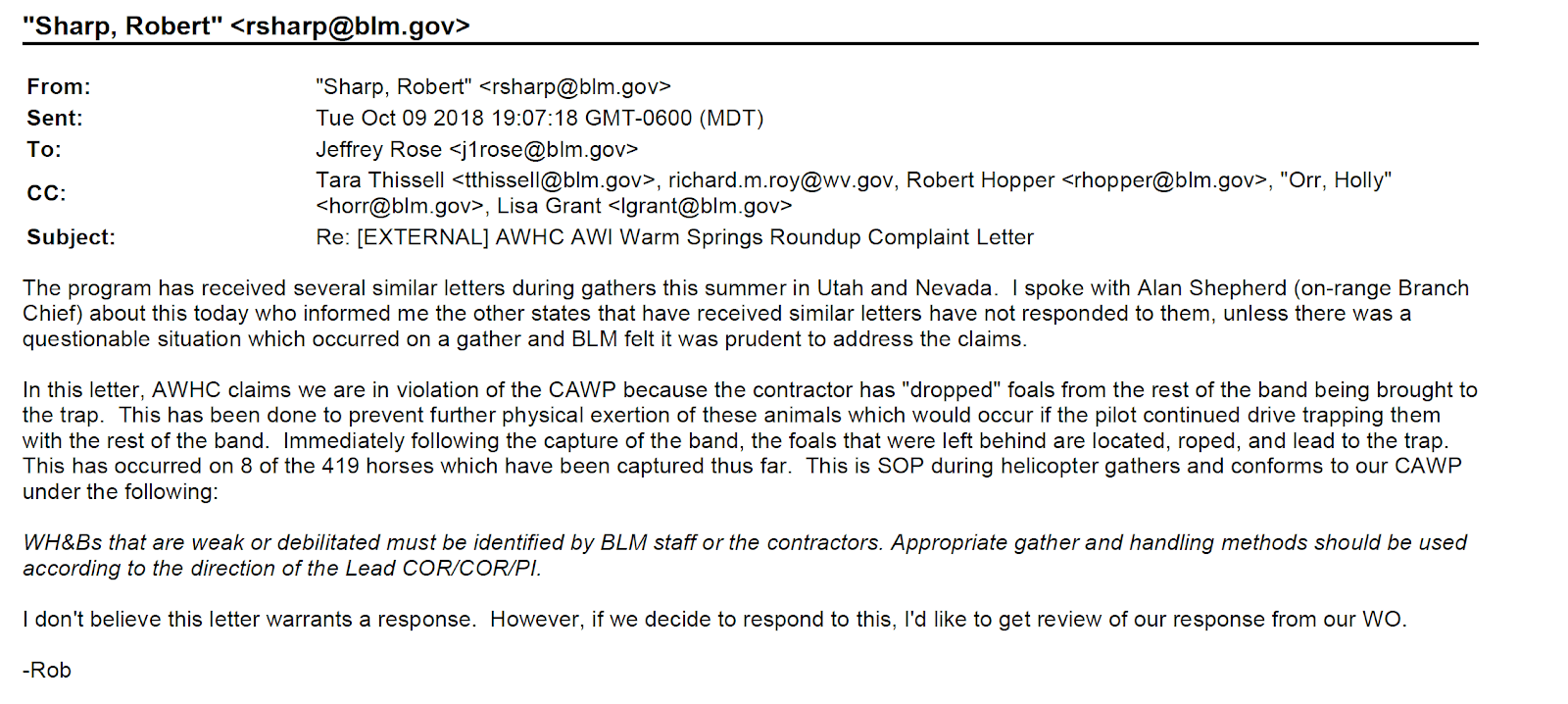
The FOIA documents revealed a history of disregard for public input on wild horse welfare duringroundups. Emails betweenBLMemployees discussed whether to respond to our complaint letter about violations observed by our field representative. We sent aletteron October 8, expressing concerns about horses being pushed too fast, causing foals to fall behind. The documents confirmed foals dying from capture shock and incorrect pairings at the trap site.
Internal emails concluded our letter did not warrant a response, despite discussions. Employees shared a canned response approved by the Washington, D.C. office after a similar complaint during another roundup.
TheBLM’s disregard for our concerns, validated by FOIA records, shows a broken management system harmful to federally-protected wild horses and burros. TheBLM's refusal to engage with the public demonstrates a lack of transparency in managing wild horses and spending tax dollars.
Moving Forward
Vet forms from the FOIA documents include suggestions for the Animal and Plant Health Inspection Service (APHIS) to better assist theBLM’sWild Horse and Burro Program. One vet suggested a foal kit to support separated foals' health, including a nasogastric tube, electrolytes, and milk replacer. American Wild Horse Conservation was shocked to learn this kit is not available, hoping it will be included in the future.
Subscribe to our newsletter: