
USFS Transfers Management of California Wild Horses to Local Cattle Interests
Wild Horse Management
Read time: 12 Minutes
Published: March 7, 2019
Written by:
AWHC Contributor
(March 8, 2019)
PART 1: DEVASTATING CONSEQUENCES
According to the Wild Free-Roaming Horse and Burro Act of 1971, the Bureau of Land Management (BLM) and the United States Forest Service (USFS) are tasked with managing, protecting, and controlling wild horses and burros on federal lands that they administer.
But theUSFShas abdicated that responsibility in the case of federally protected wild horses residing in the Devil’s Garden Wild Horse Territory (the Territory) on the Modoc National Forest near Alturas, CA.
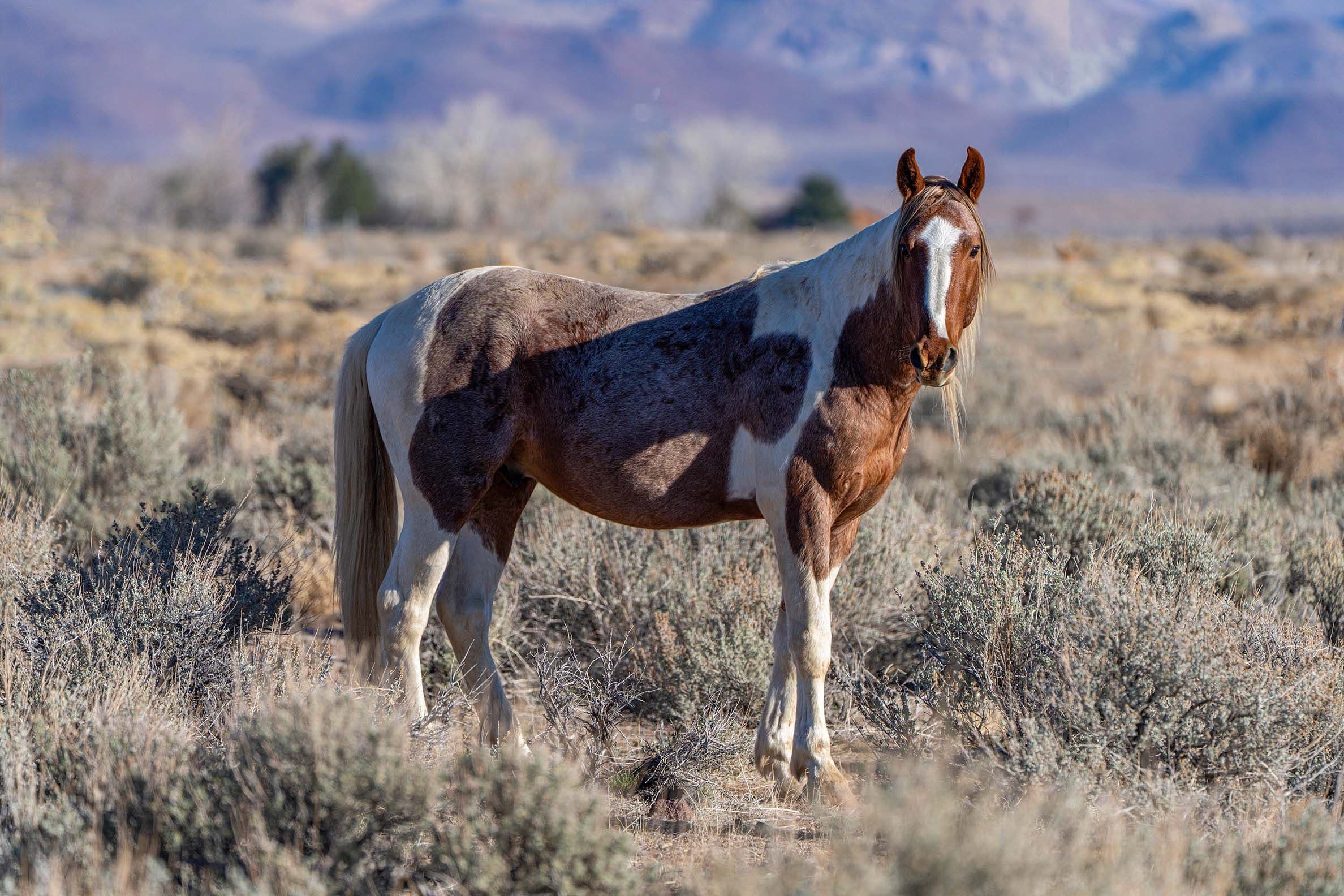
Although the 300,000-acre Territory is home to California’s largest remaining wild horse herd, it’s increasingly endangered largely because of the unprecedented role that ranch and farm groups in Modoc County, along with the University of California Cooperative Extension, have played in all aspects of theUSFS’s roundup and removal, holding, and disposition of these iconic animals, including the unprecedented plan to sell federally protected wild horses without limitation on slaughter.
The results of theUSFShanding the reins ofwild horse managementover to the Modoc County Farm Bureau and other livestock-related organizations have been nothing less than devastating for the Devil’s Garden horses – California’s most significant and genetically healthy wild horse population. For example,
· The 2013 Devil’s GardenWild Horse ManagementPlan set a population limit (“Appropriate” Management Level or AML) of just 206-402 wild horses in order to maintain grazing for nearly 6,000 privately owned livestock (3,000 cow/calf pairs and 2,900 sheep) on thepublic landswithin the Territory. The plan called for a series of mass roundups to reduce the population to this low number, which equates to a maximum of 1 horse per 750 acres of public land.
· The first roundup took place in 2016 when theUSFSrounded up and permanently removed 167 horses in and around the Territory. The horses were sent to theBLM’s Litchfield Corrals in Susanville, CA where 40 Devil’s Garden horses died, including 25 foals born there.
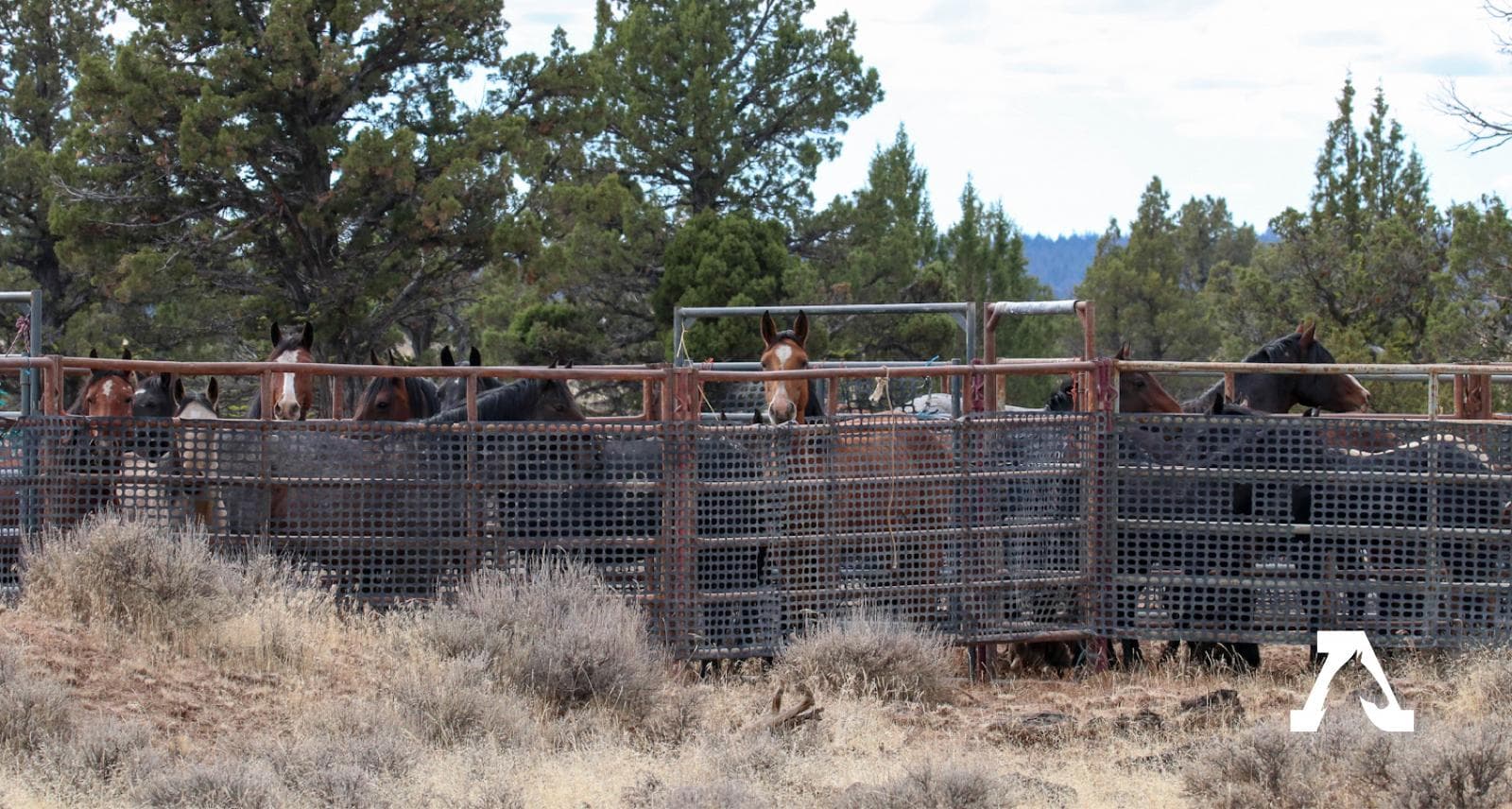
· In 2018, theUSFSrounded up and removed 932 wild horses from the Territory. (At least 20 horses died during the roundup or in holding, including 7 who were euthanized for Pigeon Fever, a non-fatal, treatable illness.) Older horses were sent to theUSFS’s Modoc corrals, which are operated and staffed by the Farm Bureau, for sale “without limitation.” Younger horses were sent to theBLMLitchfield corrals to be processed for adoption. (Under federal law, horses under age 10 must be put up for adoption three times before they can be sold.)
· Over the next few years, additionalroundupsare planned to remove thousands of more wild horses from the Territory.
So how did the Modoc County Farm Bureau et al. garner such power and control over the federally protected Devil’s Garden wild horses and theUSFS? Primarily through three strategies – orchestrated mostly by Sean Curtis, a rancher in Modoc County – employed to ensure that locallivestockinterests trumped established federal policy, law, and the public interest in protecting wild horses.
These three strategies were:
· Securing funding, mostly federal and some private, that supportsroundupsand removals of the horses in order to restore private grazing privileges;
· Launching a vocal “coordination” movement in Modoc County that pushes for local control offederal lands; and
· Initiating biased, agenda-driven “research” by Laura Snell of the University of California Cooperative Extension that scapegoats wild horses for all the damage to forage and water resources on the Territory while ignoring the impacts – current and historic – of thousands of privately-ownedlivestockthere.
AWHC has filed several Freedom of Information Act requests to obtain copies of the agreements and contracts between the United States Department of Agriculture (USDA)/USFSand the Modoc County Farm Bureau et al. We’re still waiting for those documents, but this is what we’ve pieced together so far.
PART II: FOLLOW THE MONEY
Rounding up and removing Devil’s Garden horses and warehousing them in holding corrals is a lucrative source of income for the Modoc County economy. The endless supply of mostly federal money appears to have begun in 2011 and continued at least into 2017. Admittedly, it’s a tangled and not very transparent web.
According to repeated statements by Mr. Curtis, who is a board member on the Modoc County Farm Bureau and the Modoc County Natural Resource Analyst, because the Modoc National Forest lacked the funds and resources to carry out a management program for wild horses, the local community needed to step up to provide both.
And it did – mostly by the Modoc County Farm Bureau employing retired federal and state employees for its Retired Workers Program. Ultimately, these employees would take control of every phase in the development of the Environmental Assessment (EA) of the 2013 Devil’s GardenWild Horse ManagementPlan, including setting the arbitrarily low AML of 206-402 horses and not authorizing the use offertility controluntil that AML has been reached.
The majority of funding for the plan was Resource Advisory Committee (RAC) money secured through the Secure Rural Schools and Community Self-Determination Act, a federal program that compensates rural counties for declining payments due to reduced logging onUSFSlands. Funding was also supplemented by the Modoc County Farm Bureau, Modoc County, the Modoc County Cattlemen Association, and ranchers with grazing permits on the Territory.
Here’s a list of some of that funding:
- In June 2011, Mr. Curtis successfully lobbied the Modoc County Board of Supervisors to fast-track $50,000 in RAC money to 1) begin a Retired Workers Program Pilot Project that would employ retired federal and state workers to begin data collection and environmental documentation for the wild horse roundup and removal ($10,000) and 2) contract for a wild horse and burro specialist to develop the 2013 EA and conduct an aerial census of wild horses inside and outside the Territory ($40,000).
- During the summer of 2011, the focus of the Retired Workers Program was “to collect monitoring data necessary to allow the Forest to make a determination of excess wild horses within the Devil’s Garden Wild Horse Territory, and to validate the appropriate management level.” The Modoc County Farm Bureau oversaw all the work.
- The Modoc County Cattlemen’s Association also contributed $10,000 for the wild horse and burro specialist and aerial census, and one of the wild horses and burro specialists hired was Susan Stokke, Mr. Curtis’ wife at the time. Ms. Stokke is a former BLM employee who was the subject of severalKLAS-TV, Channel 8 I-Team reportsfor her abysmal record, including low adoption and high removal rates of wild horses, as Nevada’s Wild Horse & Burro Lead.
- From a partial set of records provided by the Modoc National Forest, it appears that the Retired Workers Program received $35,000 in 2011, $65,000 in 2012, and $20,000 in 2013 in RAC funding. To determine how much of this money was designated for wild horse projects, AWHC was directed by the USFS to contact Mr. Curtis. We have done so, but have yet to receive a response.
- Between 2012 and 2016, 990s filed by the Modoc County Farm Bureau show that it distributed $368,631 to hire federal retired employees and employees to go into the field with GPS cameras to record data on wild horses and the impacts they are making on allotments. While some of this money most likely came from the RAC funding mentioned above, the source of the rest of it is unclear.
- In 2017, the Modoc County Farm Bureau received a boost in RAC funding -- $141,075 to supplement the Retired Workers Program so that employees could “continue to do work such as monitoring required by the Wild Horse Territory Plan, collect data necessary for grazing permit renewals, write NEPA documents and other critical tasks as determined by the Forest and the applicant” from 2017 to 2019.
- Also in 2017, the USDA awarded the Modoc County Farm Bureau afour-year $501,396 contractfor “Devils Garden Wild Horse Management.”
In an 11/20/2018 email, Amanda McAdams, Forest Supervisor for the Modoc National Forest, wrote, “The agreement with the Farm Bureau was to help construct and provide for supplies and management of the facility due to the FS inability to obligate funds late in our fiscal year.”
This agreement also placed Ms. Snell, the University of California Cooperative Extension Agent for Modoc County, in charge of hiring and supervising staff at the Modoc corrals. Ms. Snell has no experience handling, managing, or caring for wild horses, and the decision to put her in charge of the corrals has led toserious animal welfare concerns.
Through this arrangement, theUSFShas ceded control to the Farm Bureau to such an extent that theUSFSneeded Mr. Curtis’ approval to pay for the transport of captured Devil’s Garden horses held at the Modoc corrals to a rescue in Colorado!
PART III: EXTREME POLITICS
An obscure political movement known as the "coordination movement" has sprung up in some rural areas of the West. It's based on the misrepresentation of a provision in some environmental laws, such as the National Forest Management Act, that requires federal agencies to “coordinate” with local governments in land use planning. The "coordination movement" claims that this provisionrequiresfederal agencies such as theUSFSto comply with localpolicy.
The “coordination” movement is alive and well in Modoc County and Mr. Curtis has engineered what essentially amounts to a takeover of federal wild horsepolicyunder its banner.
In January 2016, for example, Mr. Curtis submitted a letter to the Modoc County Board of Supervisors asking it to adopt a position paper and send it to the Modoc Forest Service to address the Devil’s Garden wild horse issue.
The paper, which states that the Board of Supervisors recognizes that the excess numbers of wild horses are the most serious threat to both the environment and socio-economics of Modoc County, emphasizes that “allwild horse managementactivities should be coordinated with Modoc County.”
The Board unanimously voted to support it.
Later, in 2017, the Modoc County Cattlemen’s Association met with the Board of Supervisors to discuss the wild horse “problem” and asked members to pressure theUSFSfor an aggressive management plan. Stressing that Modoc County is a planning county and “coordinates” the management of federal lands, the presentation focused on the need for local control because the “constitution allows” for it and local enforcement because the county’s economy depends onpublic landswithin its boundaries. Humane euthanasia and “harvesting” of the Devil’s Garden wild horses was also supported.
More recently, in early February of this year, Mr. Curtis, who is considered an expert on “coordination,” gave a call-in presentation to the Crook County Natural Resources Committee in Oregon that reportedly included a summary of “coordination” accomplishments in Modoc County. Among the highlights was his declaration that retiredUSFS/BLMemployees retained by the Farm Bureau wrote the EA for the Wild Horse Management Plan and that theUSFSonly had to sign off on it.
And finally, the Americans Coordination Institute, one of several national “coordination” organizations that advocate for restoring local government to its “rightful place,” lists Mr. Curtis and Modoc County among its many successes,claimingto have "Helped maintain grazing levels and practices in Modoc County, California where Sean Curtis and Carolyn Carey and Supervisors like Nancy Huffman and citizens as June Richards became experts at coordination—working coordination magic with Forest Service andBLM."
Mr. Curtis is also a board member forthe Stand Up and Fight Clubthat fights the “effects of over-regulation and government’s heavy-handed intervention in our free enterprise” and whose purpose was described in theWashington Timesas “teaching rural America to defeat environmentalists.”
PART IV: JUNK SCIENCE
In 2015, Ms. Snell, University of California Cooperative Extension Agent and County Director, began a three-year research project that was supposed to examine the impacts of wild horses as well as cattle and other wildlife on riparian areas in the Territory.
Although the mission of the University of California Cooperative Extension is to produce “unbiased,science-basedsolutions,” it’s become evident that Ms. Snell’s study has been driven by her personal agenda to assist Modoc County ranchers in removing wild horses from the Territory.
For example, when Ms. Snell arrived in Modoc County, shedescribedbeing approached by local ranchers, asking for her help in solving the wild horse issue. Her response was to create a “study” without a scientific purpose but with a clear political intent: “to provide visuals to show people the horses and what the landscape looks like due to unmanaged grazing by the wild horses.”
Because Ms. Snell’s study had a foregone conclusion, it focused exclusively on the negative impacts of wild horses, while ignoring the impacts of the thousands of cattle and sheep who graze on the Territory.
Equally disturbing, Ms. Snell has not only used the preliminary results of her study to advocate for the removal of the Devil’s Garden horses but also to position herself as avocal supporterof horse slaughter, stating: "I really think the sale of horses should be allowed. I think if there are groups that want to buy those horses and keep them, that should be fine. If there’s a group that would like to eat those horses, I think that’s fine." Ms. Snell made these remarks as an employee of the State of California, where the cruel practice of horse slaughter has been banned for more than two decades!
Part V: VIOLATION OF PUBLIC TRUST
The Devil’s Garden wild horses – and thepublic landson which they roam -- belong to all Americans, and all Americans have a rightful say in their management. The special interest takeover of federalpolicyin the Modoc National Forest has undermined the legally-mandated protection of wild horses and the will of the vast majority of Americans who want wild horses preserved and protected on ourpublic lands. This situation warrants further investigation as it has profound implications for the management of wild horses and burros and thepublic landsthey inhabit across the West.
Subscribe to our newsletter: