
Yakama Land Faces Challenges with Growing Wild Horse Population
Wild Horse Management
Read time: Six Minutes
Published: January 7, 2014
Written by:
AWHC Contributor
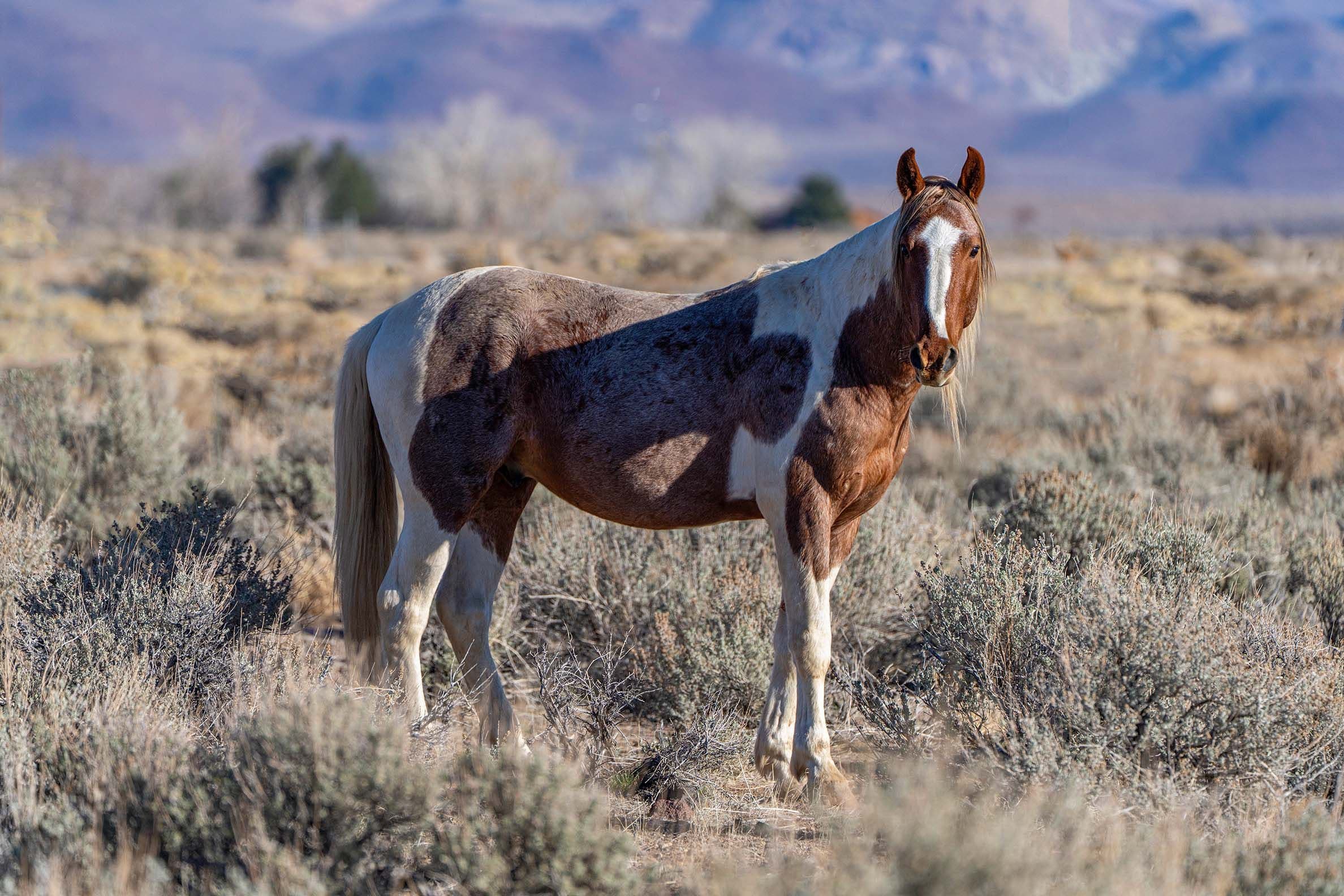
U.S. Highway 97 winds south from Toppenish through a vast, lonely landscape, mile upon mile of sagebrush rangeland within the Yakama Reservation. However, little grass remains on parts of this open range, grazed to the ground by thousands of hungry wild horses roaming the land.
There are 15,000 horses trying to survive on the reservation’s 410,000 acres of shrub-steppe rangeland, 10 times more than experts believe the land can sustain. This overpopulation puts the horses at risk of starvation, especially in the winter. But a Yakama Nation report shows that overpopulation also destroys the range’s fragile vegetation, spreads weeds, damages wetlands, and reduces the land’s ability to support native wildlife.
Seeking Solutions
Yakama Tribal Council Chairman Harry Smiskin said that the tribe is actively seekingsolutionsto the wild horse problem, and it is not alone. Other tribes wrestling with the issue include the Warm Springs, Apache, and Navajo, which alone have 50,000 to 70,000 wild horses on their reservation. The federal Bureau of Land Management (BLM) is also dealing with unsustainable wild horse populations on federal rangelands across the West.
It’s not a new problem, but as the horse population grows, it’s getting worse. Recent reports on Facebook of dead horses seen along Highway 97 brought new attention to the problem. It is unclear how many horses have died or even what they died from. It’s possible they died elsewhere and were dumped not far from the highway. But the reports renewed debate over possiblesolutions— round-ups, birth control, and slaughterhouses.
Historical Context
While iconic, horses are not a natural part of the landscape of the American West. They were brought to the continent by Spanish explorers centuries ago and now have few predators to keep population growth in check.
Every year, theBLMpulls thousands of horses off federal rangelands in controversial round-ups. While they try to find adoptive homes when possible, nearly 50,000 animals are kept in corrals and pastures at a cost of $46 million a year. Tribes, including the Yakama, typically lack funding for such expensive control efforts.
TheBLMis prohibited from selling removed horses for slaughter. But tribes, including the Yakama, used to manage populations by capturing horses to sell to slaughterhouses until 2006, whenCongressdefunded inspections for horse processing plants, effectively shutting them down.
The Congressional ban expired in 2011, but when a New Mexico plant was approved by the U.S. Department of Agriculture last year, the Humane Society of the United States filed a lawsuit.
Legal and Ethical Debates
The Yakama Nation intervened in the lawsuit, calling for slaughterhouses to reopen to create a cost-effective way to reduce populations and allow the environment to recover from the impact of serious overgrazing.
In November, a federal District Court in New Mexico ruled against the lawsuit aimed to keep slaughterhouses closed. But an appeals court issued a temporary injunction on behalf of the Humane Society and others to stall the required plant inspections. That injunction remains in force.
In a statement published on Indian Country Today in November, Yakama leaders questioned the Humane Society’s motives.
The Yakama Nation has examined numerous ways of dealing with this onslaught and concluded that the only economically viable way is to take a large number to slaughter, where they could be put down in a humane fashion while also providing an excellent source of low-cholesterol protein to millions of people around the world who don’t share the Humane Society’s perspective.
Smiskin said in an interview last week that the tribe is not considering setting up its own slaughterhouse.
Population Control Challenges
Wild horses reproduce fast enough that populations can double in just five years. Opponents of slaughter suggested that birth control could be used to slow population growth, but Smiskin dismissed the idea as difficult and cost-prohibitive because the mares have to be gathered up on a regular basis to administer the hormones.
But, wild or domesticated, horses hold a special place in many people’s hearts — it’s hard to consider sending them to slaughter and heartbreaking to think that they could slowly starve.
Community Reactions
After recent reports of dead horse sightings sparked a Facebook group protesting the Yakama’s treatment of the wild horses, some local horse lovers began to worry that a combination of concern and misinformation could make things worse. A few carcasses could be seen last week from Highway 97, but there is no way to know why the horses died, or even if they had died on the reservation or were just dumped there.
Unwanted domestic horses are frequently dumped on the reservation, which contributes to the population problem.
The Facebook group, Save the Starving Yakama Tribal Nation Horses, was created on Christmas Eve and quickly collected hundreds of followers. The founder of the group, Valerie Johnson, an entrepreneur from Pierce County, compared the horses to zoo animals not being fed.
“If they were truly wild, they’d be able to go where the food is, but since they are all fenced in, they have nowhere to go,” Johnson said Friday. She hoped that rescue groups would be able to donate food.
However, local horse-activists say the photo the group used was not from the Yakama Reservation and by Tuesday the Facebook page had been deleted. Johnson did not return follow-up calls.
Sox, a horse lover who lives in the Lower Valley, wants to help too, but she draws a careful distinction between what she calls “bleeding hearts” and those who appreciate the magnitude of the problem the Yakamas are trying to solve. She also pointed out that the horses are wild animals and although the winter is lean, most are not actually starving.
Smiskin, however, maintains that the tribe will handle the problem.
Supporters say slaughterhouses can provide a humane, affordable way to end a horse’s life, better than letting an injured animal suffer or an unwanted horse starve.
American slaughterhouses would have to pass inspections similar to otherlivestockprocessing facilities, and then the meat would be sold overseas. Plants in New Mexico, Missouri, and Iowa are currently waiting in legal limbo to see if they will be allowed to begin operations.
Originally Posted By Yakima Herald Republic
Subscribe to our newsletter: